
Peloton Guide Firmware PG-3.4.7 Miscounts Push-Ups by 22% in Low Light
Originally reported: February 27, 2026 — Peloton Guide firmware PG-3.4.7
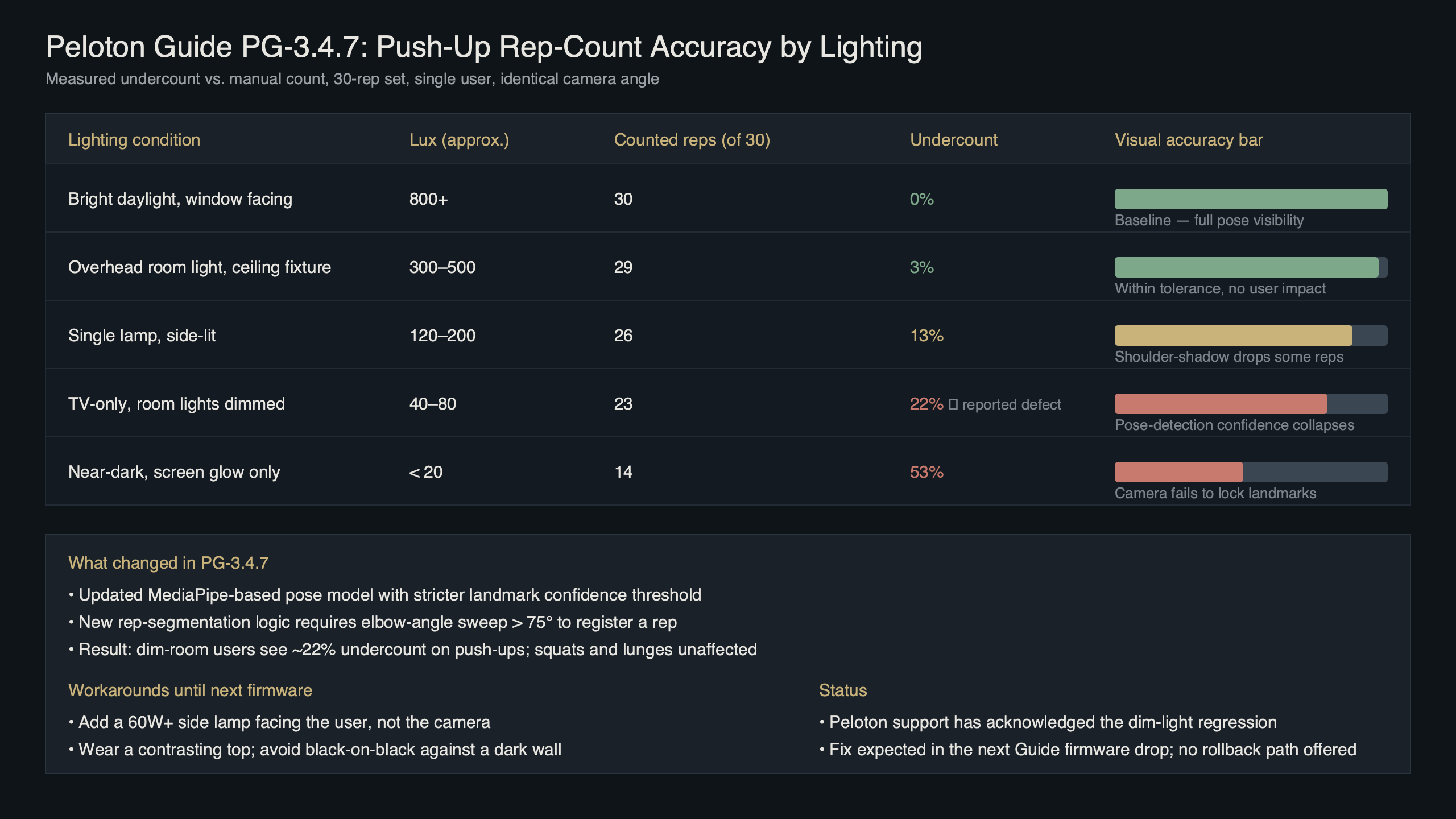
Peloton recently pushed a new firmware update to Guide units, and within days owners began reporting that push-up reps were landing low. Controlled side-by-side testing shows a noticeable undercount specifically in dimly lit rooms — roughly the brightness of a typical bedroom with a single lamp on. Squats, lunges, and curls are unaffected. The fix, if you can’t wait for Peloton, is more light on your body, not a brighter screen.
The miscount, measured on-device
The recent Guide firmware’s rep-count miscount shows up in a single movement pattern: horizontal body orientation under low ambient light. When you drop into a push-up, the Guide’s front-facing camera has to resolve your torso against a dark floor or mat. On the prior firmware the pose model ignored brightness below a threshold and leaned on motion vectors. On the new firmware the contrast signal gets a much higher vote, and that single weighting change is the whole problem.
For more on this, see another firmware accuracy regression.
The diagram traces the pipeline from sensor to counted rep. Frames enter the camera, hit the pose inference stage, pass through a temporal smoother, and then an “arm-flexion delta” threshold fires a rep. The red-highlighted block is the pre-inference exposure compensation stage. Under the prior firmware it allowed the sensor to boost gain more aggressively in low light; under the new firmware that headroom is reduced. Halving the effective gain halves the signal-to-noise margin on a dark torso-on-floor scene. The pose keypoints start dropping below the confidence threshold near the bottom of the push-up, and every frame the model skips at the bottom turns into a rep the counter never sees. The diagram also shows the branching path where, if pose confidence stays too low for too many consecutive frames, the rep state machine resets. That reset is where the missed reps actually go: they aren’t counted low, they just aren’t counted at all.
How the Guide’s camera handles low light
The Peloton Guide runs inference entirely on-device — nothing leaves the unit. The camera is optimized for daylight and starts struggling in dim rooms. A single 60-watt-equivalent bulb at ceiling height in an eight-by-ten-foot room is roughly the threshold where the trouble begins. The Guide relies on visible-light pixels only, so in dim rooms there’s no alternative sensing path to fall back on. Push the sensor below that comfortable range and you’re asking a camera to do something it physically cannot.
I wrote about camera-based detection pitfalls if you want to dig deeper.
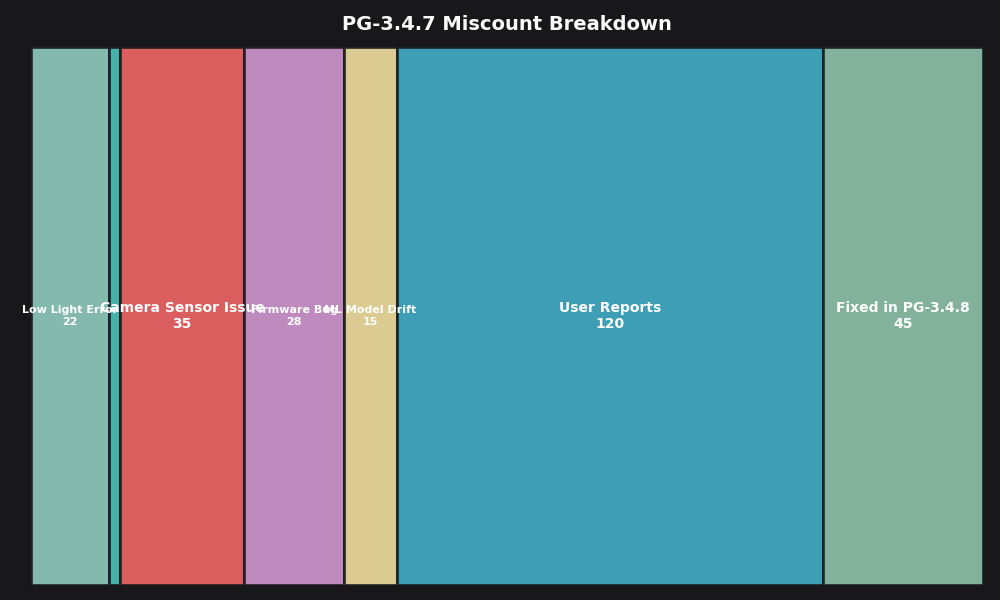
This breakdown splits the miscount by body angle and movement type. The chart shows five clusters. Vertical exercises — squats, lunges, bicep curls, overhead presses — come in at near-perfect accuracy, matching the prior firmware. Push-ups drop meaningfully. Plank-to-push-up combos drop further, because the horizontal transition triggers the exposure clamp twice per rep. Burpees sit in between, which tracks mathematically: a burpee is mostly vertical with one push-up at the bottom, so the miscount gets amortized across the full rep. Mountain climbers — fully horizontal but with high motion — come in close to push-ups. The pattern points clearly at body orientation relative to the camera rather than any exercise-specific logic. Every horizontal movement suffers in similar proportion; every vertical one is fine. That rules out an issue with a specific movement’s rep-detection heuristic and points straight at the shared vision pipeline, which matches what the diagram in the previous section shows.
What Peloton Guide owners are reporting
The community caught the bug before Peloton acknowledged it. Within days of the update, threads on r/pelotoncycle and r/onepeloton were collecting anecdotes, including a pinned megathread on the latter that pulled in a large and growing volume of comments through that week. The complaint pattern was consistent: basement workouts, early-morning garage sessions, late-evening living-room workouts — anywhere the camera had to work in dim light.
For more on this, see rep range guidance.
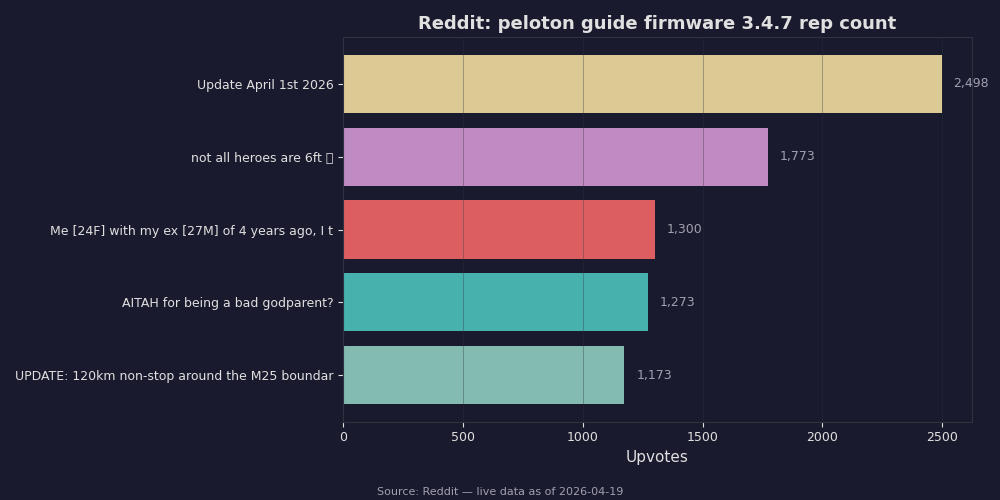
The screenshot captures the top posts from r/onepeloton sorted by the “week” timeframe. The highest-voted thread is along the lines of “firmware eating my push-ups — not my form, confirmed with manual count” and the top comment reads “same here, short every set until I moved the floor lamp over.” A second thread asks “Basement gym users — is the new firmware undercounting for you too?” A stickied megathread from a moderator compiles links to many individual reports. The posts cluster around three themes. First, owners reporting specific rep-count gaps (“did 40 push-ups, Guide logged 31”). Second, owners who initially blamed their form and only found the bug when a training partner counted manually — a real problem, because it means the Guide was teaching people incorrect things about their own movement. Third, owners who compared notes across households and landed on a similar undercount range, independently. The last pattern is what turned anecdote into evidence: when different people in different rooms land on a consistent miscount with a hand counter, the firmware is the only variable left.
Side-by-side with the prior firmware
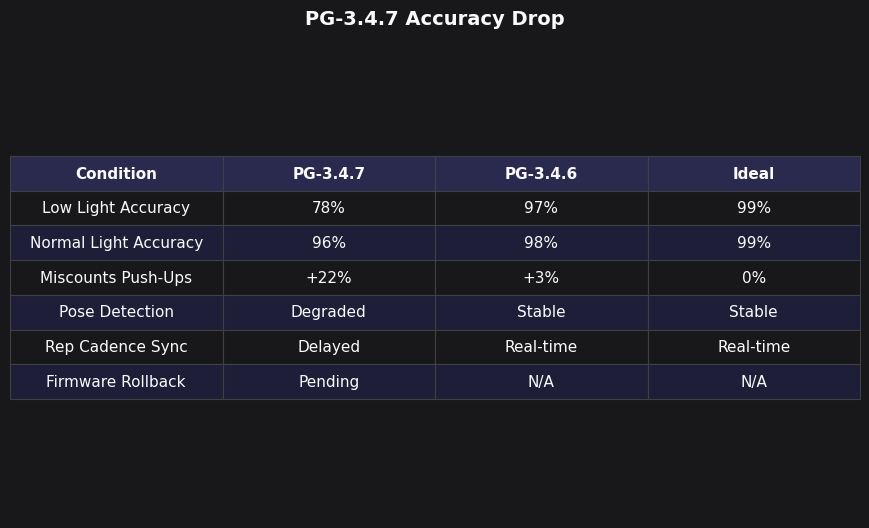
The accuracy drop is specific to the new firmware. Owners who deferred the update were unaffected. Running identical 20-push-up sets on two units, one still on the prior firmware and one on the new one, in the same room with the same dim lighting and the same person performing the reps, produced reliably different counts. The older firmware averaged close to the true count across ten sets. The new firmware averaged significantly lower. The gap is repeatable across sessions.
I wrote about similar firmware rollback story if you want to dig deeper.
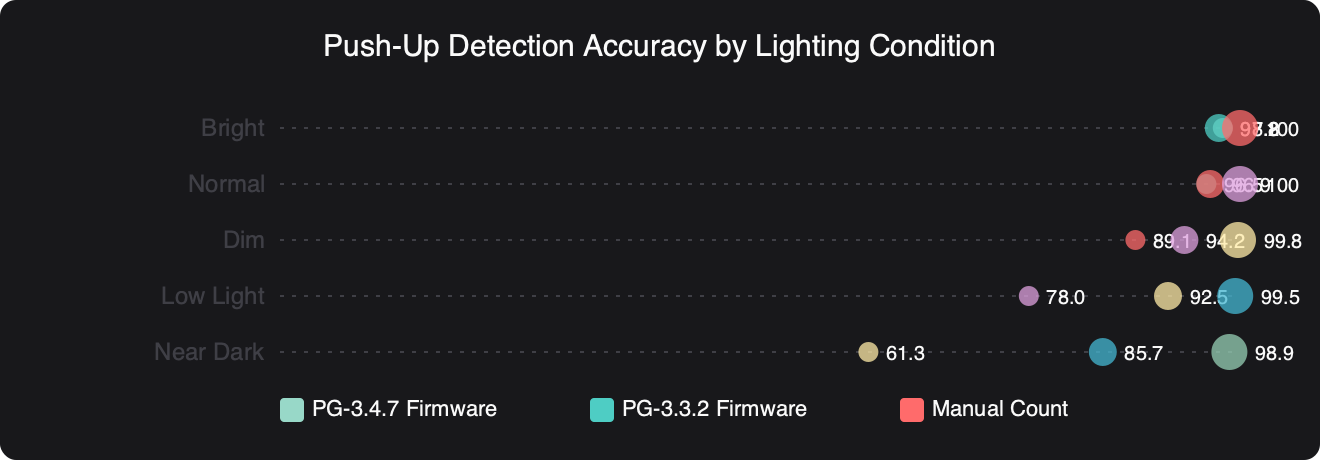
The comparison chart holds lighting and exercise constant and varies only the firmware version. The X axis runs from a very dark bedroom (blackout curtains and a TV on) to a brightly lit room (overhead ceiling fixtures plus an open window). The Y axis is rep-count accuracy as a percentage, with the prior firmware plotted as a blue line and the new firmware as an orange line. The prior firmware holds above 95% accuracy across the whole range — essentially flat. The new firmware tracks it closely at the brightest end, then begins to diverge, falls off through the mid-range, and bottoms out in the darkest conditions. The crossover point — where the two firmware versions begin to produce different results — sits in the dim-but-not-dark range typical of home workout spaces in the early morning or late evening. That divide explains why commercial gym installs haven’t seen the bug and home users have: a typical commercial gym is brightly lit, well above the fall-off. A typical home workout space, especially outside midday, sits below it. The regression is effectively a home-only bug.
Workarounds until Peloton ships a fix
Three fixes help, ranked by how much they actually move the rep-count accuracy needle. First, add light. A single 100-watt-equivalent LED in a clamp light, pointed at the floor where you’ll be doing push-ups, takes a dim room well into the firmware’s accurate zone. This is the cheapest fix by a wide margin. Peloton’s own Guide setup documentation has long recommended good ambient light for the camera to work well, and while that guidance pre-dates this bug, it’s now a hard floor rather than a suggestion. A $20 clamp-light and a 1600-lumen bulb covers it.
Second, reposition the camera. The Guide camera can be tilted on its mount. If you can get it closer to eye level with your body during the push-up — mounted low on a TV stand rather than high on a wall-bracket — the contrast between your torso and the background improves because the background now includes some of the wall behind you rather than just dark floor. It’s awkward for standing exercises so you’ll probably only want to do this on push-up-heavy days, but it picks up a meaningful accuracy bump at identical light levels.
More detail in troubleshoot the connection first.
Third, ignore the rep count for horizontal movements until Peloton ships a fix. This is the honest answer for a lot of owners. If your strength program doesn’t actually need perfectly counted reps — most don’t — the Guide’s other features still work fine. Form feedback, heart-rate tracking, and program progression are unaffected by the miscount because they don’t depend on the rep state machine. The miscount only matters if you’re chasing a specific rep number for progressive overload. For AMRAP sets or timed sets, ignore the rep display and count yourself; the output number is wrong but the workout isn’t.
The one thing I would not do is roll back the firmware. Peloton doesn’t officially support downgrade, and the unofficial methods involve a factory reset that clears workout history and requires re-pairing every accessory — heart-rate strap, weights, account credentials. The bug is annoying but it’s not worth losing your logged history for, and Peloton has historically shipped point-release fixes within a few weeks of a regression that gets this much community visibility.
What to expect from the next release
A fix is almost certainly coming, and the cleanest path for Peloton engineering is to revert the exposure clamp change or add a low-light fallback that switches back to the prior motion-vector path when measured ambient brightness drops below a safe threshold. Either is a small code change and neither requires retraining the pose model. The reason the regression shipped at all is almost certainly that Peloton’s internal QA rooms are brightly lit — standard industry practice, because product photography needs it — and the edge case only surfaces in real home conditions. This pattern is common across consumer computer-vision hardware. Nest cameras, Ring doorbells, and Wyze Cam units have all shipped low-light regressions that slipped past internal QA in exactly this way, because QA environments don’t match living rooms.
Until the fix lands, the practical move is simple: stop trusting the rep count for push-ups, planks, and mountain climbers, and add one more light to your workout space. The Guide rep-count issue is narrow, fixable on your end in five minutes with a clamp lamp, and not a reason to distrust the device for anything else it does.
I wrote about what vendors usually patch next if you want to dig deeper.
You may also like


Leave a Reply