
Skip to content

Menu

Archives

  • April 2026
  • February 2026
  • January 2026
  • December 2025
  • November 2025
  • October 2025
  • September 2025
  • August 2025
  • October 2023
  • September 2023
  • August 2023
  • July 2023
  • June 2023
  • May 2023
  • April 2023
  • March 2023
  • February 2023
  • January 2023
  • December 2022
  • November 2022
  • October 2022
  • September 2022
  • August 2022
  • June 2022
  • May 2022
  • April 2022
  • March 2022
  • January 2022
  • December 2021
  • November 2021
  • October 2021
  • August 2021
  • November 2020
  • July 2020
  • May 2020
  • April 2020
  • March 2020
  • August 2018
  • July 2018
  • June 2018
  • April 2018
  • March 2018

Calendar

April 2026
M T W T F S S
 12345
6789101112
13141516171819
20212223242526
27282930  
« Feb    

Categories

  • Aftercare Procedures
  • Age Groups
  • AI/ML
  • Alternative Medicine
  • Ambient Computing
  • Animal Health
  • Animal Husbandry
  • Animals
  • Anti-Aging
  • API Development
  • Apple Ecosystem
  • Architectural Design
  • Art And Technology
  • Auditory Science
  • Augmented Reality
  • Automation
  • Babies
  • Baby
  • Beauty & Skincare
  • Beauty Industry
  • Biohacking
  • Biomechanics
  • Book Reviews
  • Breastfeeding
  • Budget Tips
  • Budgeting
  • Budgeting Strategies
  • Business
  • Cable Management
  • Cardiovascular Health
  • Career Advice
  • Career Development
  • Career Growth
  • Cats
  • Chess
  • Chronobeauty
  • Circular Economy
  • Civic Technology
  • Cleaning Tips
  • Cloud Computing
  • Cognitive Health
  • Cognitive Performance
  • Cognitive Science
  • Community
  • Community Building
  • Community Engagement
  • Community Living
  • Computer Vision
  • Consumer Guides
  • Consumer Trends
  • Container Gardening
  • Content Analysis
  • Content Non-Technical
  • Content Strategy
  • Cooking Techniques
  • Cooking Tips
  • Cosmetic Chemistry
  • Cultural Events
  • Cycling
  • Data Analysis
  • Data Engineering
  • Data Governance
  • Data Science
  • Database
  • Design Psychology
  • Design Trends
  • Developer Productivity
  • DevOps
  • Diet
  • Diet
  • Diet And Nutrition
  • Digital Identity
  • Digital Media
  • Digital Wellbeing
  • DIY
  • DIY Projects
  • Dogs
  • Engineering Culture
  • Entertainment News
  • Environmental Impact
  • Environmental Science
  • Equity Compensation
  • Ethical AI
  • Exercise
  • Exercise Science
  • Exercise Technique
  • Exotic Pets
  • Fall Gardening
  • Family
  • Family Health
  • Family Life
  • Fashion Business
  • Fashion Industry
  • Fashion News
  • Fashion Tech
  • Financial Analysis
  • Financial Optimization
  • Financial Planning
  • Flooring Maintenance
  • Food
  • Food Psychology
  • Food Safety
  • Food Science
  • Food Tech
  • Functional Fitness
  • Functional Training
  • Future Of Work
  • Garden Care
  • Garden Maintenance
  • Gardening Tips
  • Geospatial Data
  • Gig Economy
  • Greece
  • Greek
  • Greek Food
  • Green Technology
  • Gymnastics
  • Hardware Engineering
  • Health
  • Health & Wellness
  • Health And Wellness
  • Health Informatics
  • Health Science
  • Health Tech
  • Health Technology
  • Healthcare
  • Healthcare Management
  • Healthy Eating
  • Healthy Recipes
  • Holistic Health
  • Holistic Wellness
  • Home & Living
  • Home Decor
  • Home Financing
  • Home Health
  • Home Improvement
  • Home Maintenance
  • Home Organization
  • Home Styling
  • Horticulture
  • Household Chemistry
  • Identity Management
  • Indian Cuisine
  • Indoor Gardening
  • Industrial Design
  • Industry Analysis
  • Infant Nutrition
  • Infrastructure Management
  • Ingredient Deep Dive
  • Integrative Health
  • Integrative Medicine
  • Interior Design
  • Internet of Things
  • Internet of Things (IoT)
  • Invalid Request
  • Investment Strategies
  • Investment Strategy
  • IoT
  • Kids
  • Leadership Development
  • Learning Strategies
  • Lifestyle
  • Lifestyle Brands
  • Lifestyle News
  • Lifestyle Optimization
  • Literary Criticism
  • Literature
  • Logistics Management
  • Machine Learning
  • Material Science
  • Materials Science
  • Meal Planning
  • Media Analysis
  • Meditation
  • Mental Health
  • Mental Performance
  • Mental Wellness
  • Miami
  • Miami Food
  • Mind And Body
  • Minimalism
  • Mobile Development
  • Neuroscience
  • No Applicable Categories
  • Nursing
  • Nutrition
  • Nutrition News
  • Open Source
  • Operating Systems
  • Operational Resilience
  • Opinion
  • Organization Tips
  • Outdoor Living
  • Over 40
  • Over 50
  • Over 60
  • Parenting
  • Parenting
  • Parenting Strategies
  • Performance
  • Performance Optimization
  • Personal Development
  • Personal Finance
  • Personal Growth
  • Personal Productivity
  • Pet Care
  • Pet Safety
  • Philosophy
  • Plant Biology
  • Plant Care
  • Politics
  • Product Formulation
  • Productivity
  • Productivity Engineering
  • Protein
  • Psychology
  • Psychology of Space
  • Quantified Self
  • Reading Culture
  • Real Estate Investment
  • Recipe Development
  • Recipes
  • Regulatory Compliance
  • Remote Work
  • Renovation Planning
  • Resource Management
  • Respiratory Health
  • Responsible Pet Ownership
  • Retail Strategy
  • Retail Technology
  • Robotics
  • Science
  • Seafood
  • Seasonal Gardening
  • Security
  • Sedentary Health
  • Self-Care
  • Skincare Science
  • Skincare Trends
  • Sleep
  • Sleep Health
  • Smart Home
  • Social Impact
  • Soft Skills
  • Soil Health
  • Spatial Computing
  • Spatial Design
  • Stress Management
  • Supplements
  • Sustainability
  • Sustainability Science
  • Sustainable Engineering
  • Sustainable Fashion
  • Systems Engineering
  • Tax Optimization
  • Tax Strategy
  • Tech Investment
  • Technical Writing
  • Technology For Home
  • Testing
  • Travel
  • Travel News
  • Travel Safety
  • Travel Tips
  • Trend Analysis
  • Tropical Plants
  • Urban Gardening
  • Urban Planning
  • User Experience
  • Veggie
  • Vietnam
  • Virtual Events
  • Volunteering
  • Wealth Management
  • Wearable Technology
  • Web Development
  • Wellness
  • Wellness Technology
  • Winter Gardening
  • Work-Life Balance
  • Workplace Culture
  • Workspace Setup
  • World
  • Writing
  • Writing Skills
  • Year In Review
  • Yoga
  • Yoga News
  • Zero Waste

Copyright Unbiased Living | Real Reviews & Practical Advice 2026 | Theme by ThemeinProgress | Proudly powered by WordPress

Unbiased Living | Real Reviews & Practical Advice
You are here :
  • Home
  • Gardening Tips ,
  • Plant Care ,
  • Urban Gardening
  • Hard Water Is Halving Your Container Tomato Yield: A pH Fix
Written by Naomi DuboisApril 14, 2026

Hard Water Is Halving Your Container Tomato Yield: A pH Fix

Gardening Tips . Plant Care . Urban Gardening Article

Municipal water above 150 ppm calcium carbonate pushes container soil pH past 7.5 within weeks of consistent watering. At that pH, tomatoes lose access to iron, manganese, and phosphorus — three nutrients that directly control fruit set and sizing. The fix is straightforward: test your water, calculate the pH adjustment needed, and acidify either the water itself or the growing medium. A $12 pH meter and a bag of elemental sulfur or a jug of white vinegar are usually all it takes to bring yields back to normal.
Topic overview for Hard Water Is Halving Your Container Tomato Yield: A pH Fix
Topic overview — Hard Water Is Halving Your Container Tomato Yield: A pH Fix.

That chart gives a high-level view of the problem, but the mechanism matters. Tomatoes (Solanum lycopersicum) perform best in a pH range of 6.0 to 6.8. Container mixes — typically peat, perlite, and coco coir — start in that range. But unlike garden beds, containers have no surrounding soil mass to buffer pH swings. Every time hard water runs through a 5-gallon pot, dissolved calcium and magnesium carbonates accumulate. There’s nowhere for them to go. The pH creeps upward, and nutrient lockout follows.

Why Does Hard Water Damage Container Tomatoes More Than In-Ground Plants?

Containers concentrate mineral deposits because the growing volume is small and drainage carries away acids faster than it carries away alkaline salts. In-ground plants have hundreds of gallons of surrounding soil to dilute incoming minerals.

Think of it in raw numbers. A 5-gallon container holds roughly 0.67 cubic feet of growing medium. If your tap water measures 250 ppm hardness (classified as “very hard” by the USGS Water Science School), and you water with half a gallon daily through peak summer, you’re depositing about 470 milligrams of dissolved calcium carbonate into that small volume every single day. Over a 90-day growing season, that’s over 42 grams of calcium carbonate packed into 0.67 cubic feet of medium. The pH impact is real and measurable — typically a rise of 0.5 to 1.5 pH units across a single season.

In-ground beds dilute that same mineral load across a vastly larger soil volume, and the natural microbial activity and organic matter in field soil buffers pH changes more effectively than a peat-perlite mix ever can. Container growers don’t have that safety net.

How Hard Is Your Tap Water?

Check your municipal water quality report first — every U.S. public water system publishes one annually, and it lists hardness in ppm or mg/L of calcium carbonate. You can also test directly with a TDS meter, though TDS includes all dissolved solids, not just hardness minerals.

Here’s the practical classification that matters for container gardening:

  • 0–60 ppm: Soft. No pH adjustment needed for tomatoes.
  • 61–120 ppm: Moderately hard. Monitor pH monthly; you may need minor corrections mid-season.
  • 121–180 ppm: Hard. Plan on acidifying your water or amending your medium from the start.
  • 180+ ppm: Very hard. Active pH management is non-negotiable for container tomatoes.

Well water in limestone regions (much of the Midwest, Florida, and the Texas Hill Country) routinely tests above 250 ppm. City water in Phoenix, Las Vegas, and San Antonio often lands between 200 and 400 ppm. If you’re in one of these areas, hard water is the default — not the exception.
Reddit top posts about hard water container garden tomato yield
Live data: top Reddit posts about “hard water container garden tomato yield” by upvotes.

The community discussion shown above reflects what growers in hard-water regions report consistently: stunted plants, yellowing between leaf veins (interveinal chlorosis), and disappointing fruit counts despite adequate fertilizer. The common thread is almost always pH-driven nutrient lockout, not a fertilizer deficiency.

What Happens When Container Soil pH Climbs Above 7.0?

Nutrient availability in soil is pH-dependent. Above pH 7.0, iron, manganese, zinc, copper, and boron become increasingly insoluble and unavailable to roots — even when those elements are physically present in the growing medium.

The University of Massachusetts Amherst Extension publishes a well-known nutrient availability chart showing that iron availability drops sharply above pH 6.5, and by pH 7.5 it’s functionally locked out of soilless media. For tomatoes, iron deficiency alone reduces chlorophyll production, slows photosynthesis, and cuts fruit yield. But it rarely travels alone — manganese and phosphorus lockout follow the same curve, compounding the damage.

For more on this, see pH-sensitive houseplants.
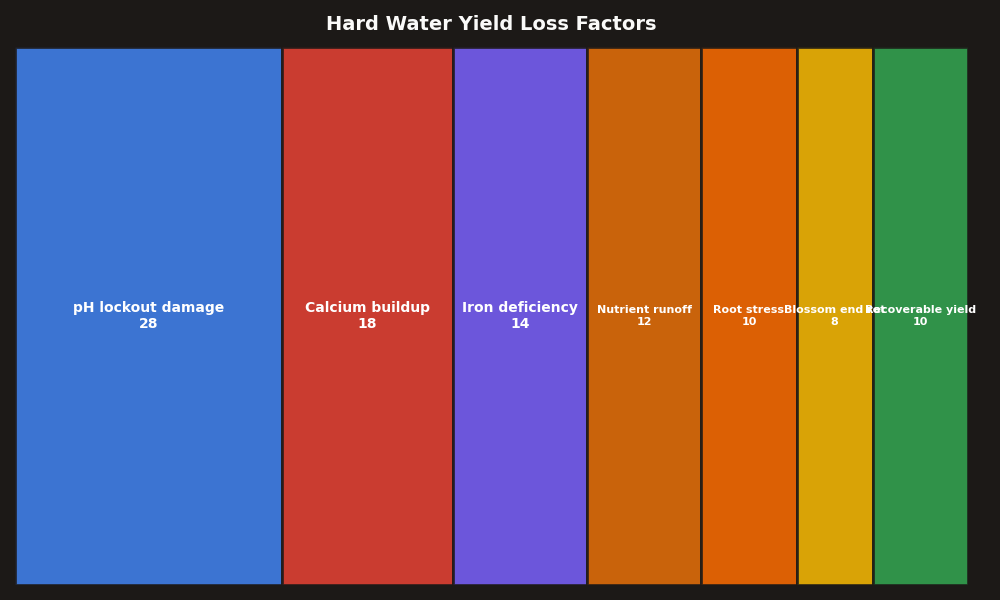
Breakdown: Hard Water Yield Loss Factors
Category breakdown — Hard Water Yield Loss Factors.

That breakdown of yield-loss factors shows the compounding effect. Iron chlorosis reduces photosynthetic output. Phosphorus lockout impairs flower development and fruit set. Manganese deficiency weakens cell walls and disease resistance. Together, these factors can cut fruit production by 40 to 60 percent compared to the same plant growing at pH 6.2 in the same container with the same fertilizer. The limiting factor isn’t nutrition — it’s access to nutrition.

A common misdiagnosis here is calcium deficiency causing blossom end rot. Growers see the symptoms, add more calcium (lime, gypsum, calcium sprays), and make the pH problem worse. Blossom end rot in containers is more often caused by inconsistent watering disrupting calcium transport — not by low calcium levels in the medium. Hard water typically supplies plenty of calcium. Adding more is counterproductive.

Step-by-Step: Testing and Adjusting Your Container pH

This is the hands-on section. Follow these steps at the start of the growing season and recheck every two to three weeks through harvest.

Step 1: Test Your Water Source

Use a digital pH meter (the Apera PH20 or Bluelab pH Pen are reliable options in the $50–$90 range) to measure your tap or well water directly. Write down both the pH and, if you have a TDS meter, the total dissolved solids reading. Municipal tap water in hard-water areas typically reads pH 7.4 to 8.2.

Step 2: Test Your Container Medium

Use the pour-through method, which is the standard for soilless media. Water your container until you get runoff, collect the runoff in a clean cup, and test the pH of that runoff. This gives you the effective root-zone pH.

  1. Water the container thoroughly with plain tap water.
  2. Wait 30 minutes for the medium to equilibrate.
  3. Pour enough water through the top to collect 50–100 mL of leachate from the drainage holes.
  4. Test the leachate pH immediately.

If the leachate reads above 6.8, your medium is already drifting high for tomatoes. Above 7.2, you’re in active nutrient lockout territory.

Step 3: Acidify Your Irrigation Water

The simplest ongoing fix is to lower the pH of your water before it hits the container. Two common household options work:

White vinegar (5% acetic acid): Add 1 tablespoon per gallon of tap water as a starting point, then test. For water starting at pH 7.8–8.0, this usually brings it down to the 6.2–6.5 range. Adjust the dose up or down based on your meter reading. Vinegar is cheap and widely available, but the acetic acid breaks down quickly in soil, so it doesn’t have a lasting acidifying effect on the medium itself — you need to treat every watering.

Citric acid: Use 1/4 teaspoon per gallon as a starting dose. Citric acid is a bit more predictable than vinegar in terms of dosing, and it’s available in bulk from brewing or canning suppliers for around $8–$12 per pound. Same limitation as vinegar — it treats the water, not the medium long-term.

For either method, mix the acid into your watering can, wait 60 seconds, then test pH before watering. Target a pH of 6.0 to 6.5 in the treated water. This gives the medium a slight acid push at each watering, counteracting the ongoing carbonate accumulation.

Step 4: Amend the Growing Medium Directly

If your leachate pH is already above 7.5, water acidification alone may take weeks to bring it down. A direct amendment speeds things up.

Elemental sulfur: Soil microbes convert elemental sulfur to sulfuric acid over several weeks. For a 5-gallon container, mix in 1 teaspoon (about 5 grams) of elemental sulfur into the top 2 inches of medium and water in. This is a slow-release approach — expect pH movement over 2 to 4 weeks. Don’t overdo it; too much sulfur can crash pH below 5.0 and burn roots. Retest in 2 weeks before adding more.

Aluminum sulfate: Acts faster than elemental sulfur because it doesn’t depend on microbial conversion. Use 1/2 tablespoon per gallon of medium. Dissolve in water and drench. Retest in 3–5 days. The Clemson Cooperative Extension’s soil pH fact sheet recommends aluminum sulfate for situations requiring faster correction, but notes it should be used with care in containers due to the risk of aluminum toxicity if overapplied.
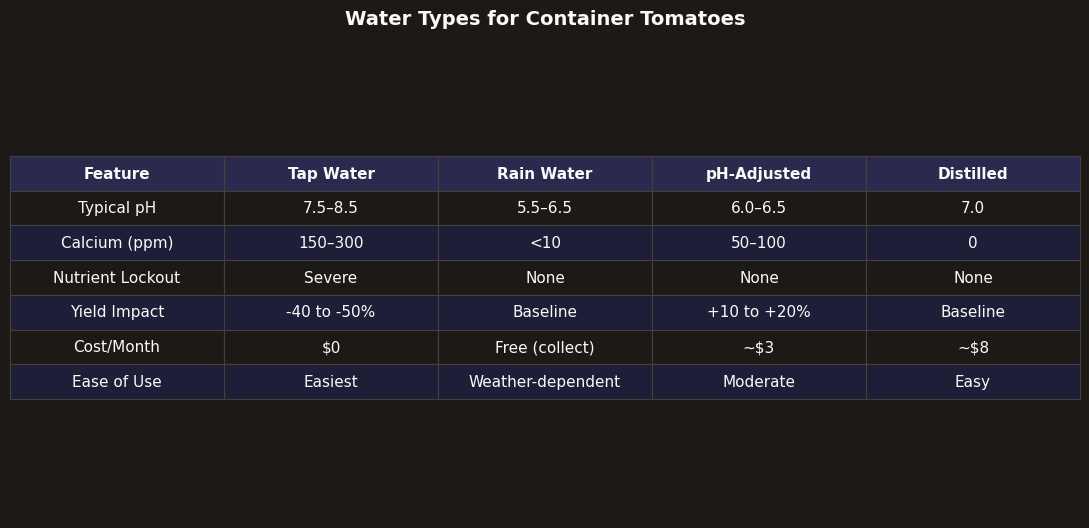
Comparison: Water Types for Container Tomatoes
Feature comparison — Water Types for Container Tomatoes.

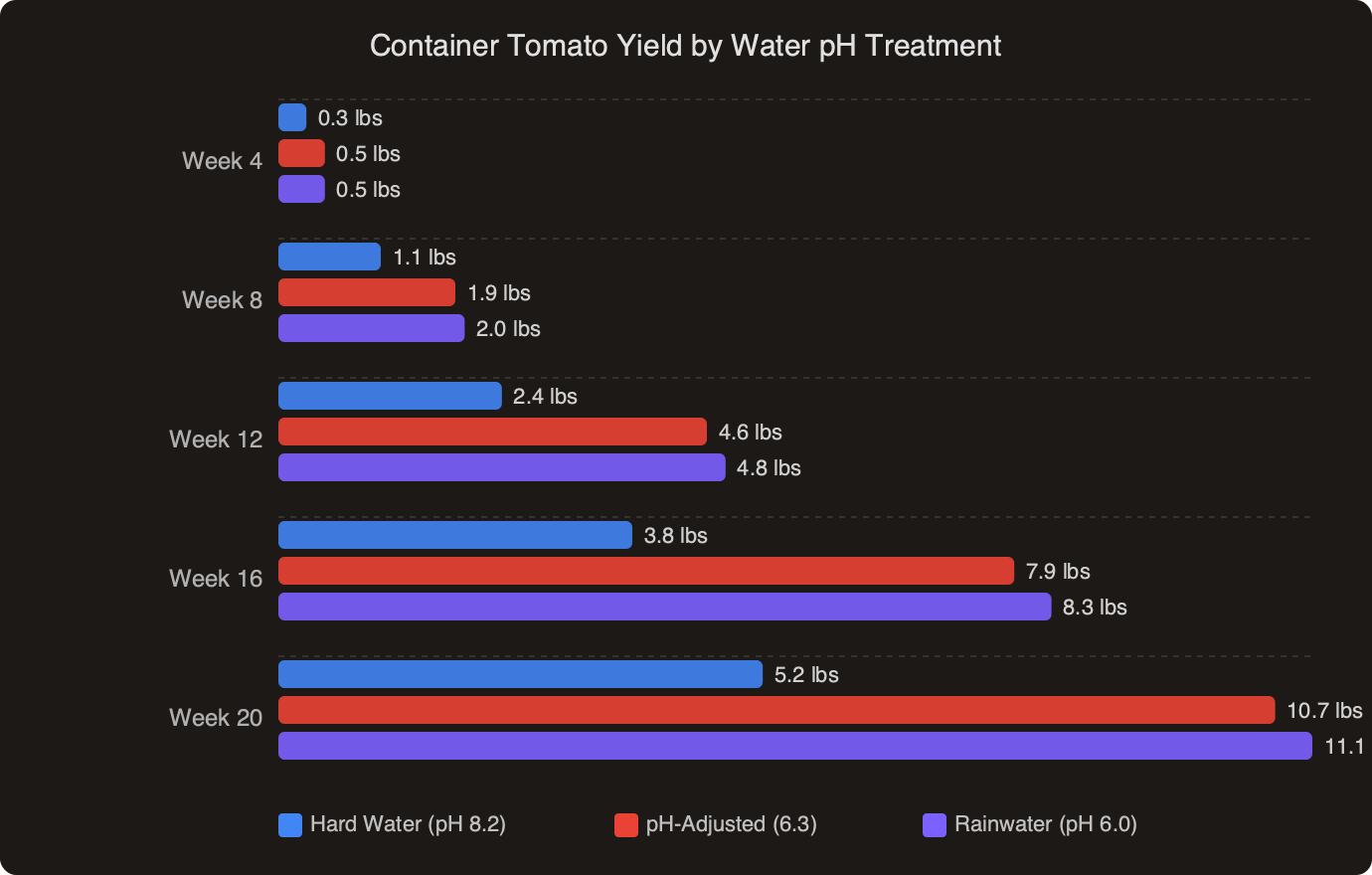
That comparison of water types for container tomatoes makes the yield difference concrete. Growers using rainwater or RO-filtered water (both near-zero hardness) consistently outperform those using untreated hard tap water in otherwise identical setups. Filtered water eliminates the pH management problem entirely, but it adds cost and complexity — a small RO unit runs $150–$300 and wastes 2–4 gallons per gallon produced. For most home growers, acidifying tap water is the practical middle ground.

Which Acidifying Strategy Works Best Long-Term?

For a full growing season, combining two approaches gives the most stable results: acidify your irrigation water at every watering (vinegar or citric acid) and apply a small dose of elemental sulfur at planting time and again at mid-season.

The water treatment handles the incoming alkalinity in real time. The sulfur provides a slow background acidification that catches any drift between waterings. Together, they keep the root zone in the 6.0–6.8 window with minimal fuss.

For more on this, see balcony drip irrigation systems.

Some growers switch entirely to rainwater collection, which typically comes in at pH 5.5–6.0 with near-zero hardness. A single rain barrel (50 gallons) can sustain 8–10 five-gallon containers through a typical week in summer, depending on rainfall. This eliminates the hard water problem at the source. But in arid regions where container gardening is most common — the Southwest, parts of Texas, Southern California — rainfall is too inconsistent to rely on.

Peat-heavy mixes offer more natural pH buffering than coco coir-based blends. Peat moss is naturally acidic (pH 3.5–4.5), so a mix containing 50% or more peat starts lower and resists upward pH drift longer. If you’re mixing your own container medium in a hard-water area, increasing the peat ratio from the typical 30–40% to 50–60% gives you a meaningful head start. Balance the extra peat with additional perlite to maintain drainage.

What About pH-Down Products From Hydroponic Suppliers?

General Hydroponics pH Down (phosphoric acid) and similar products from hydroponic shops work perfectly for this application. They’re more concentrated and more precisely titratable than vinegar. A 1-quart bottle costs around $12 and lasts an entire season for a small container garden. The main advantage is dose consistency — you’ll dial in your drops-per-gallon ratio once, and it stays reliable because the acid concentration is standardized. The downside is the phosphoric acid adds phosphorus to your feed, which may matter if you’re already running a phosphorus-heavy fertilizer.

How Often Should You Retest Container pH?

Every two weeks during the growing season. That’s the minimum. If you’re growing in a hard-water area (above 180 ppm) and using untreated water on hot days when you water twice daily, test weekly.

The pour-through test described in Step 2 takes under five minutes. Keep a simple log — date, leachate pH, any amendments applied. pH problems in containers develop gradually, and without a record, you won’t notice the trend until your plants show visible deficiency symptoms. By that point, you’ve already lost weeks of potential fruit production.

Yellowing between leaf veins on newer growth (interveinal chlorosis) is the most visible sign of iron lockout from high pH. If you see it, test immediately — don’t guess. Foliar iron sprays (chelated iron, like Fe-EDDHA) can provide a quick rescue while you bring the root zone pH down, but they treat the symptom, not the cause. Fix the pH and the iron availability corrects itself within a week or two.

Mid-season is the most common time for pH problems to surface. The first month of the season, your fresh potting mix holds its buffering capacity. By July and August, after dozens of hard-water irrigations, that buffer is exhausted and pH climbs quickly. This is exactly when tomatoes are setting their heaviest fruit loads and need peak nutrient access. If you only test pH once per season, make it early July.

Container tomato yield is determined by a chain of inputs — light, temperature, fertilizer, water quality. Hard water is the weak link that most growers overlook, and it’s the one that undermines everything else. A well-fed tomato plant growing in medium with a pH of 7.8 will always underperform a moderately fed plant at pH 6.3. Get the water right first. Everything else you do for that plant works better once the root zone pH is where it should be.

You may also like

Blumat vs Drip Irrigation on a 40-Square-Foot Balcony Garden

April 14, 2026

What a $50 Weekly Meal Plan Does to Your CGM Readings

April 12, 2026

Why My Monstera’s New Leaves Keep Tearing Before They Unfurl

April 11, 2026
Tags: Fitness Tips, Home Improvement, Interior Design, Lifestyle News, Meditation, Mental Health, Mindfulness, Nutrition News, Yoga News

Leave a Reply Cancel reply

Your email address will not be published. Required fields are marked *

Recipe Rating


Archives

  • April 2026
  • February 2026
  • January 2026
  • December 2025
  • November 2025
  • October 2025
  • September 2025
  • August 2025
  • October 2023
  • September 2023
  • August 2023
  • July 2023
  • June 2023
  • May 2023
  • April 2023
  • March 2023
  • February 2023
  • January 2023
  • December 2022
  • November 2022
  • October 2022
  • September 2022
  • August 2022
  • June 2022
  • May 2022
  • April 2022
  • March 2022
  • January 2022
  • December 2021
  • November 2021
  • October 2021
  • August 2021
  • November 2020
  • July 2020
  • May 2020
  • April 2020
  • March 2020
  • August 2018
  • July 2018
  • June 2018
  • April 2018
  • March 2018

Calendar

April 2026
M T W T F S S
 12345
6789101112
13141516171819
20212223242526
27282930  
« Feb    

Categories

  • Aftercare Procedures
  • Age Groups
  • AI/ML
  • Alternative Medicine
  • Ambient Computing
  • Animal Health
  • Animal Husbandry
  • Animals
  • Anti-Aging
  • API Development
  • Apple Ecosystem
  • Architectural Design
  • Art And Technology
  • Auditory Science
  • Augmented Reality
  • Automation
  • Babies
  • Baby
  • Beauty & Skincare
  • Beauty Industry
  • Biohacking
  • Biomechanics
  • Book Reviews
  • Breastfeeding
  • Budget Tips
  • Budgeting
  • Budgeting Strategies
  • Business
  • Cable Management
  • Cardiovascular Health
  • Career Advice
  • Career Development
  • Career Growth
  • Cats
  • Chess
  • Chronobeauty
  • Circular Economy
  • Civic Technology
  • Cleaning Tips
  • Cloud Computing
  • Cognitive Health
  • Cognitive Performance
  • Cognitive Science
  • Community
  • Community Building
  • Community Engagement
  • Community Living
  • Computer Vision
  • Consumer Guides
  • Consumer Trends
  • Container Gardening
  • Content Analysis
  • Content Non-Technical
  • Content Strategy
  • Cooking Techniques
  • Cooking Tips
  • Cosmetic Chemistry
  • Cultural Events
  • Cycling
  • Data Analysis
  • Data Engineering
  • Data Governance
  • Data Science
  • Database
  • Design Psychology
  • Design Trends
  • Developer Productivity
  • DevOps
  • Diet
  • Diet
  • Diet And Nutrition
  • Digital Identity
  • Digital Media
  • Digital Wellbeing
  • DIY
  • DIY Projects
  • Dogs
  • Engineering Culture
  • Entertainment News
  • Environmental Impact
  • Environmental Science
  • Equity Compensation
  • Ethical AI
  • Exercise
  • Exercise Science
  • Exercise Technique
  • Exotic Pets
  • Fall Gardening
  • Family
  • Family Health
  • Family Life
  • Fashion Business
  • Fashion Industry
  • Fashion News
  • Fashion Tech
  • Financial Analysis
  • Financial Optimization
  • Financial Planning
  • Flooring Maintenance
  • Food
  • Food Psychology
  • Food Safety
  • Food Science
  • Food Tech
  • Functional Fitness
  • Functional Training
  • Future Of Work
  • Garden Care
  • Garden Maintenance
  • Gardening Tips
  • Geospatial Data
  • Gig Economy
  • Greece
  • Greek
  • Greek Food
  • Green Technology
  • Gymnastics
  • Hardware Engineering
  • Health
  • Health & Wellness
  • Health And Wellness
  • Health Informatics
  • Health Science
  • Health Tech
  • Health Technology
  • Healthcare
  • Healthcare Management
  • Healthy Eating
  • Healthy Recipes
  • Holistic Health
  • Holistic Wellness
  • Home & Living
  • Home Decor
  • Home Financing
  • Home Health
  • Home Improvement
  • Home Maintenance
  • Home Organization
  • Home Styling
  • Horticulture
  • Household Chemistry
  • Identity Management
  • Indian Cuisine
  • Indoor Gardening
  • Industrial Design
  • Industry Analysis
  • Infant Nutrition
  • Infrastructure Management
  • Ingredient Deep Dive
  • Integrative Health
  • Integrative Medicine
  • Interior Design
  • Internet of Things
  • Internet of Things (IoT)
  • Invalid Request
  • Investment Strategies
  • Investment Strategy
  • IoT
  • Kids
  • Leadership Development
  • Learning Strategies
  • Lifestyle
  • Lifestyle Brands
  • Lifestyle News
  • Lifestyle Optimization
  • Literary Criticism
  • Literature
  • Logistics Management
  • Machine Learning
  • Material Science
  • Materials Science
  • Meal Planning
  • Media Analysis
  • Meditation
  • Mental Health
  • Mental Performance
  • Mental Wellness
  • Miami
  • Miami Food
  • Mind And Body
  • Minimalism
  • Mobile Development
  • Neuroscience
  • No Applicable Categories
  • Nursing
  • Nutrition
  • Nutrition News
  • Open Source
  • Operating Systems
  • Operational Resilience
  • Opinion
  • Organization Tips
  • Outdoor Living
  • Over 40
  • Over 50
  • Over 60
  • Parenting
  • Parenting
  • Parenting Strategies
  • Performance
  • Performance Optimization
  • Personal Development
  • Personal Finance
  • Personal Growth
  • Personal Productivity
  • Pet Care
  • Pet Safety
  • Philosophy
  • Plant Biology
  • Plant Care
  • Politics
  • Product Formulation
  • Productivity
  • Productivity Engineering
  • Protein
  • Psychology
  • Psychology of Space
  • Quantified Self
  • Reading Culture
  • Real Estate Investment
  • Recipe Development
  • Recipes
  • Regulatory Compliance
  • Remote Work
  • Renovation Planning
  • Resource Management
  • Respiratory Health
  • Responsible Pet Ownership
  • Retail Strategy
  • Retail Technology
  • Robotics
  • Science
  • Seafood
  • Seasonal Gardening
  • Security
  • Sedentary Health
  • Self-Care
  • Skincare Science
  • Skincare Trends
  • Sleep
  • Sleep Health
  • Smart Home
  • Social Impact
  • Soft Skills
  • Soil Health
  • Spatial Computing
  • Spatial Design
  • Stress Management
  • Supplements
  • Sustainability
  • Sustainability Science
  • Sustainable Engineering
  • Sustainable Fashion
  • Systems Engineering
  • Tax Optimization
  • Tax Strategy
  • Tech Investment
  • Technical Writing
  • Technology For Home
  • Testing
  • Travel
  • Travel News
  • Travel Safety
  • Travel Tips
  • Trend Analysis
  • Tropical Plants
  • Urban Gardening
  • Urban Planning
  • User Experience
  • Veggie
  • Vietnam
  • Virtual Events
  • Volunteering
  • Wealth Management
  • Wearable Technology
  • Web Development
  • Wellness
  • Wellness Technology
  • Winter Gardening
  • Work-Life Balance
  • Workplace Culture
  • Workspace Setup
  • World
  • Writing
  • Writing Skills
  • Year In Review
  • Yoga
  • Yoga News
  • Zero Waste

Sections

Copyright Unbiased Living | Real Reviews & Practical Advice 2026 | Theme by ThemeinProgress | Proudly powered by WordPress