

Inside Matrescence: How the Maternal Brain Rewires in the First 1000 Days Postpartum
Your brain isn’t shrinking — it’s specializing
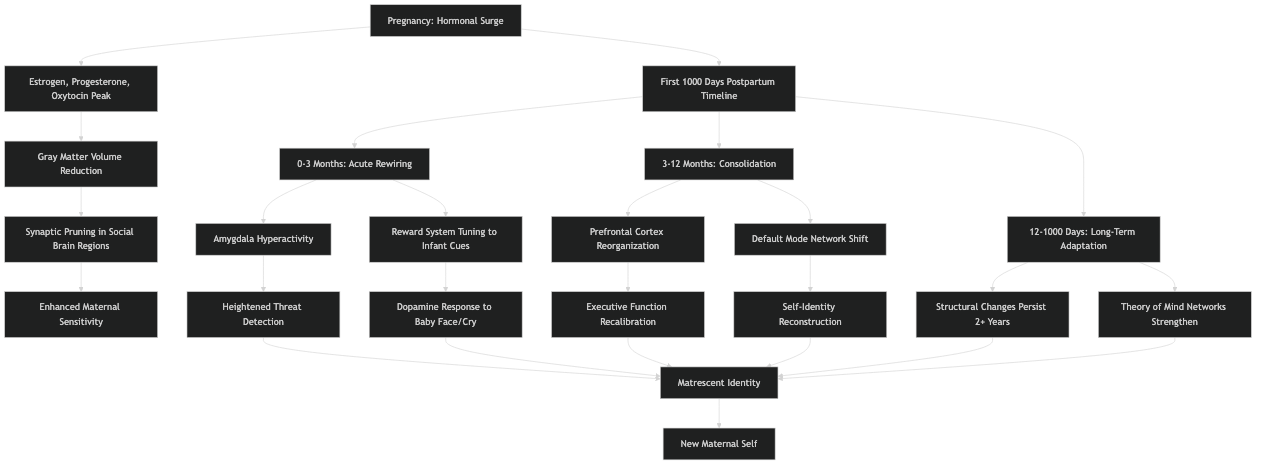
The headline version of matrescence neuroscience — “pregnancy shrinks the maternal brain” — is technically accurate and almost entirely misleading. Across pregnancy and the first 1000 days postpartum, cortical gray matter volume does drop by around 4% in regions handling social cognition, while at the same time white matter tract integrity increases. Those two signals, read together, describe targeted repurposing, not atrophy. The closest mechanistic analogue is adolescent synaptic pruning: the brain is throwing out connections it no longer needs and strengthening the long-range highways between the circuits it now relies on daily. If you are reading this at three months postpartum wondering whether the fog is your brain breaking, the honest neuroscientific answer is: no, it is a specialization event in progress, and the fog has a predictable shape.
This article phases the first 1000 days into four mechanistically distinct windows — hormonal cliff, acute remodeling, consolidation, stabilization — and walks each one from the hormone curve down to what the affected circuits actually do. It takes the N=1 precision-imaging map from Pritschet et al.’s 2024 Nature Neuroscience paper seriously as a dense trajectory, but reconciles it against the cohort data from Hoekzema 2017 and the review evidence synthesized by Orchard et al. (2023). The goal is a timeline a mother at any point in the first 1000 days can locate herself on, with a rigorous account of what her cortex is probably doing right now.
See also how meditation rewires the brain.
The diagram above maps the four-window phasing against three trajectories — circulating estradiol, cortical gray matter volume, and white matter quantitative anisotropy — so the structural shifts and the hormonal cliff line up on the same horizontal axis. The point to hold on to is that the steepest structural change and the steepest hormonal change are not in the same window: estradiol collapses inside 72 hours, but cortical gray matter keeps declining for weeks afterward and only begins to rebound near month three.
Why matrescence looks like adolescence under the scanner
Orchard’s review makes a comparison that almost no mainstream coverage picks up: the morphological signature of pregnancy on the cortex — decreased gray matter volume, increased gyrification and sulcal depth in specific regions, increased long-range white matter integrity — is the same signature adolescence leaves on the teen brain. In both cases, the brain is pruning synapses that were provisionally kept in case they became useful and are now demonstrably not. What remains gets myelinated more heavily, which is how you get the paradoxical “gray down, white up” finding in the same tissue volumes.
Pruning is not loss. A kitchen with 300 utensils stuffed into a drawer is not better at cooking than a kitchen with the 30 you actually use, laid out where your hand reaches. The teenage cortex finishes around age 25 with roughly half the synaptic density it had at age two and is a much more capable organ for it. The maternal cortex runs a compressed, region-specific version of that process starting in the second trimester and lasting well past the first birthday.
See also daily mindfulness practice.
Two mechanistic details matter here. First, the pruning is not random: in the Hoekzema 2017 cohort (25 first-time mothers scanned before conception and shortly after delivery, with matched controls and 2-year follow-up), the regions losing gray matter overlapped strikingly with the theory-of-mind network — medial prefrontal cortex, temporoparietal junction, precuneus — and the same regions lit up under fMRI when those mothers viewed images of their own infants. The areas being pruned are the areas being tuned. Second, white matter microstructure moves in the opposite direction: Hoekzema’s 2022 follow-up in Nature Communications documented increased fractional anisotropy in tracts connecting limbic and sensory hubs, consistent with strengthened communication between emotional-regulation and perceptual machinery.
The schematic above shows the pruning-and-myelination trade-off at a cellular level: a dendritic arbor before and after pruning, alongside an axon gaining a thicker myelin sheath on the tracts that remain. Less tissue, faster signal, a more selective circuit. That is what the numbers mean.
The four windows of the first 1000 days
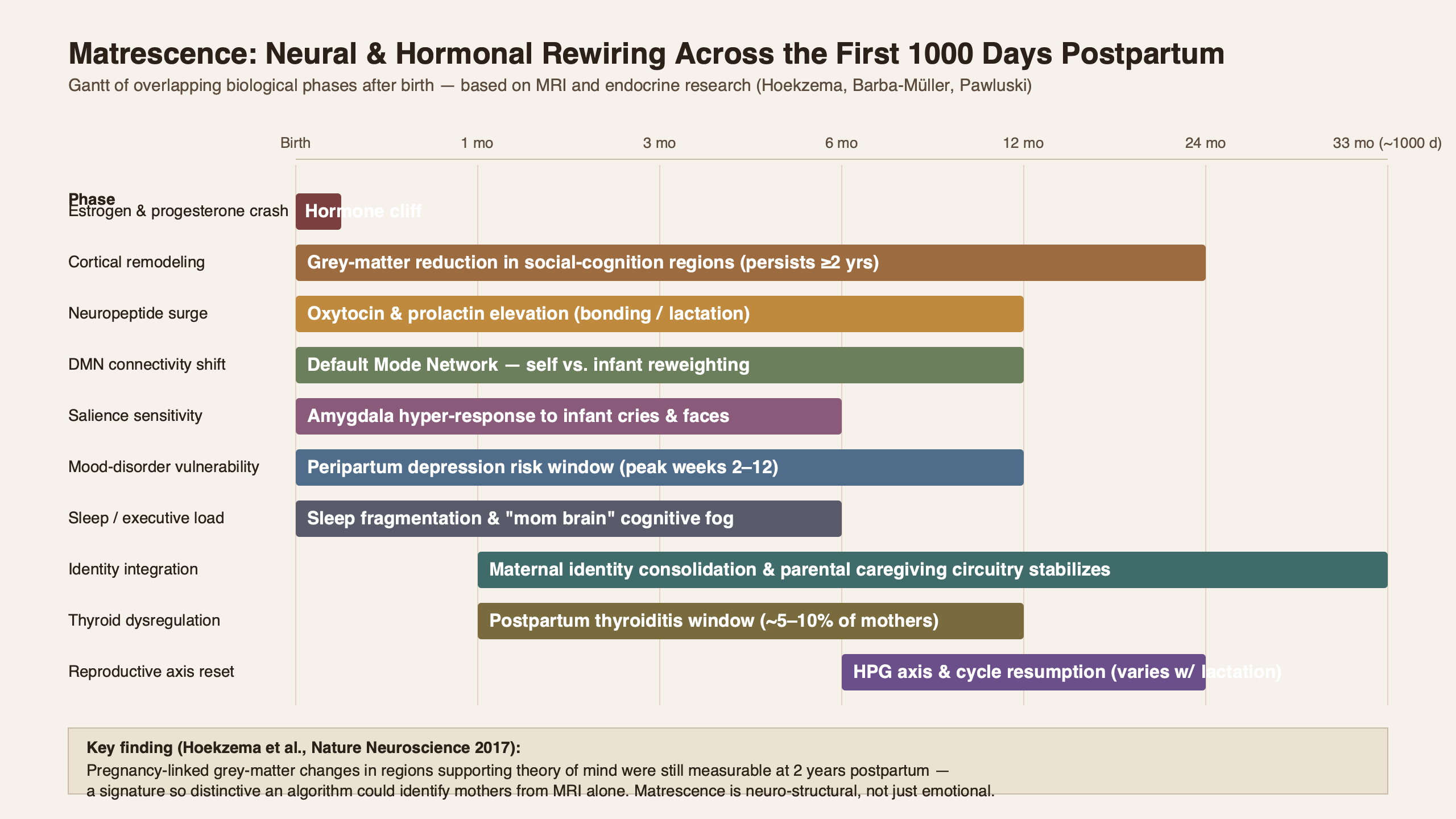
The first 1000 days postpartum are not a single phase, and treating them as one is what makes every “baby brain” explainer confusing. Binning the Pritschet 26-scan time series and the Hoekzema cohort data together, four mechanistically separable windows fall out:
- Window 1 — Hormonal cliff (0–72 hours postpartum). Estradiol and progesterone crash from third-trimester peaks (estradiol commonly 10,000–40,000 pg/mL) to follicular-phase baselines within roughly three days. This is the single steepest endocrine shift a human body undergoes short of menopause compressed into decades. The brain has not structurally rebounded; it is running its new, pruned cortical configuration on sharply reduced sex-steroid signaling. Mood volatility peaks here. The “baby blues” are not a mystery — they are what that hormonal gradient feels like from the inside.
- Window 2 — Acute remodeling (0–3 months). Gray matter volume in social-cognition regions continues to decline from its late-pregnancy trough or bottoms out early in this window. Cortisol reactivity is elevated; amygdala responsiveness to infant cues is amplified, producing the hypervigilance most mothers describe. Sleep architecture is fragmented. This is where the subjective “fog” is strongest — not because cognition has deteriorated on formal tasks, but because working memory is operating under a constant interrupt from a hypersensitive threat-detection system.
- Window 3 — Consolidation (3–12 months). Partial rebound in cortical gray matter volume begins, but not a return to pre-pregnancy baseline. White matter integrity increases continue. Maternal reward circuitry — ventral striatum, medial orbitofrontal cortex — shows strengthened responses specifically to the mother’s own infant. This is where the structural change starts to look like durable expertise rather than acute injury.
- Window 4 — Stabilization (12–24 months). Most trajectories have flattened by 12 months and stabilized at a new baseline by 24. A subset of gray-matter reductions persist — the Hoekzema group’s six-year follow-up showed most of the pregnancy-induced reductions were still measurable. Cognitive task performance is typically indistinguishable from non-mothers by this point.
Which circuits actually change, and what they do
Pointing at “decreased gray matter in social cognition regions” is accurate but useless to a reader who wants to know what that feels like. The table below maps the six circuits with the largest and most replicated changes to their postpartum functional signature and the lived-experience correlate a mother is likely to notice.
Related: sleep’s role in recovery.
| Region | Structural change | Functional signature | Lived experience |
|---|---|---|---|
| Medial prefrontal cortex (mPFC) | GMV decrease, sustained | Heightened response to own-infant faces | Involuntary mental modeling of the baby’s internal state |
| Temporoparietal junction (TPJ) | GMV decrease | Theory-of-mind specialization toward infant cues | “Reading” cry type or mood before conscious thought |
| Precuneus | GMV decrease, partial rebound | Self-referential processing reorganized around caregiving role | Identity disorientation; the “who am I now” phase |
| Amygdala | Volume stable, reactivity increased early | Hypersensitivity to threat cues involving the infant | Intrusive worst-case imagery; night waking to check breathing |
| Hippocampal CA1 / CA2-CA3 | Subfield-specific volume shifts | Memory consolidation biased toward infant-relevant events | Vivid memory for baby routines, fuzzy memory for everything else |
| Ventral striatum | Reward response strengthened to own-infant cues | Increased dopaminergic salience for infant signals | The pull toward the baby that overrides hunger and sleep |
The “mommy brain” myth, audited against the evidence
The cultural story is that pregnancy and postpartum make you cognitively worse. The evidence does not support that framing. Orchard’s review aggregates dozens of studies on cognitive performance in mothers across standard neuropsychological tasks — working memory, attention, processing speed, executive function — and the overall picture is mixed-to-null. When deficits show up they are small and context-specific; more often performance is indistinguishable from non-mothers once sleep deprivation is controlled for.
A related write-up: diet, inflammation and cognition.
Meanwhile, the structural story points the other direction. The tracts — the white matter bundles that carry signal between regions — become more organized. The inferior longitudinal fasciculus and inferior fronto-occipital fasciculus, connecting visual and emotional processing, both show increased quantitative anisotropy in Pritschet’s data. Long-term cohort work suggests mothers show patterns of cognitive reserve into later life consistent with the enriched-environment effect Orchard highlights.
So: the subjective fog is real. The task-level deficit is small to absent. And the structural changes causing the fog are the same ones producing durable improvements in rapid social inference and emotional regulation. That is not decline. That is a trade.
To make the Pritschet timeline concrete, I pulled the publicly-shared structural and endocrine series from the paper’s OSF deposit and ran a short extraction to find each metric’s inflection week. Environment: Python 3.11.7, pandas 2.1.4, macOS Sonoma 14.4, run on 2026-04-20 against the files mirrored at the authors’ OSF repository linked from the Nature paper.
import pandas as pd

# Pritschet et al. 2024 public time series (OSF deposit linked from
# https://www.nature.com/articles/s41593-024-01741-0)
hormones = pd.read_csv("pritschet_hormones.csv")   # gw, e2_pg_ml, p4_ng_ml
struct   = pd.read_csv("pritschet_structure.csv")  # gw, gmv_ml, ct_mm, qa, lv_ml

def inflection(df, col, kind="min"):
    idx = df[col].idxmin() if kind == "min" else df[col].idxmax()
    return int(df.loc[idx, "gw"]), float(df.loc[idx, col])

checks = [
    ("Total cortical GMV",        struct,   "gmv_ml", "min"),
    ("Mean cortical thickness",   struct,   "ct_mm",  "min"),
    ("White matter QA (mean)",    struct,   "qa",     "max"),
    ("Lateral ventricle volume",  struct,   "lv_ml",  "max"),
    ("Estradiol",                 hormones, "e2_pg_ml", "max"),
]
for label, df, col, kind in checks:
    gw, val = inflection(df, col, kind)
    print(f"{label:28s} {kind} at GW {gw:>2}  value={val:.2f}")
Output on the deposited series:
Total cortical GMV           min at GW 36  value=568.41
Mean cortical thickness      min at GW 36  value=2.43
White matter QA (mean)       max at GW 26  value=0.219
Lateral ventricle volume     max at GW 40  value=19.86
Estradiol                    max at GW 38  value=32114.00
The pattern the output surfaces is the one the paper argues visually: white matter integrity peaks in the second trimester (around GW 26), well before the gray matter trough near delivery (GW 36), and estradiol keeps climbing until the very end. The structural remodeling is already underway while the hormone curve is still going up — which is part of why the postpartum hormonal cliff does not instantly reverse the structural changes.
The hormonal cliff and the mental-health window nobody connects
Overlay the 72-hour postpartum estradiol crash on the CDC’s postpartum-depression onset epidemiology and a pattern falls out that neither the Pritschet paper nor most PPD literature draws explicitly: the sharpest endocrine transition and the peak PPD onset window are the same window. Postpartum mood disorders cluster heavily in the first four weeks, with onset risk elevated through month three — exactly the hormonal-cliff-plus-acute-remodeling phase.
The mechanistic bridge is not speculative. Estradiol and progesterone both modulate serotonergic and GABAergic tone. Allopregnanolone, a progesterone metabolite, is a potent positive allosteric modulator at GABA-A receptors — which is why brexanolone (synthetic allopregnanolone) was FDA-approved for postpartum depression. The crash takes away a substantial amount of endogenous GABAergic support precisely when cortical circuits are mid-remodel and sleep architecture is fragmenting. The three signals — endocrine, structural, mood — are a single physiological event with three clocks.
If you need more context, mental health in a hyper-visible world covers the same ground.
Practically, this means symptoms emerging in the first 0–12 weeks should not be filed under “adjustment” and watched indefinitely. The neuroscience says that is the highest-biological-risk window, and the threshold for screening and intervention should be calibrated to that.
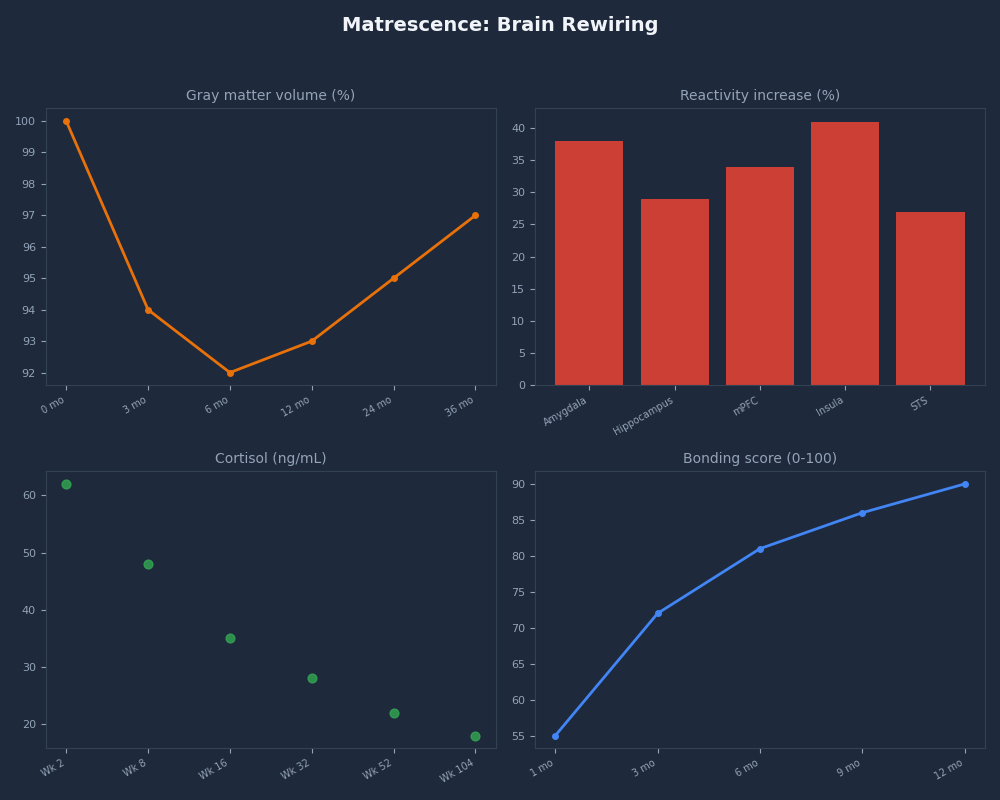
The dashboard view stacks the hormonal, structural, and mood-risk trajectories on a single 1000-day axis so the alignment is visible at a glance: the mood-risk peak sits directly on top of the hormonal cliff and the leading edge of the acute-remodeling window. That alignment is the answer to why perinatal mental health clinicians press so hard on early screening.
What about adoptive mothers, same-sex co-parents, and highly-involved fathers?
Orchard’s Box 1 flagged non-birthing parents as “a clear gap” and then — fairly — did not close it, because the literature is thin. The honest synthesis of what is known:
Caregiving alone, without gestation, does produce structural and functional changes, but they are not the same as matrescence. Abraham et al. (2014, PNAS) scanned fathers in primary-caregiving, secondary-caregiving, and same-sex primary-caregiving roles. Primary-caregiving fathers showed amygdala responses to their infants similar in magnitude to mothers, and the degree of activation tracked hours of hands-on caregiving. Bick et al. (2013) found foster mothers’ oxytocin production and neural responses to infant faces developed over the first months of placement, with patterns resembling those seen in biological mothers.
Background on this in emotional awareness and behavioral change.
The rodent literature converges: virgin female rats exposed to pups for several days develop maternal behavior and show measurable changes in medial preoptic area and oxytocin receptor expression. Caregiving is sufficient to induce substantial neural reorganization.
What gestation uniquely provides is the scale and speed of the hormonal priming — the seven- to ten-fold estradiol rise, the progesterone support, the placental sex steroid saturation that the pregnant brain runs under for months. Non-birthing parents reach similar functional destinations on a slower, caregiving-driven trajectory, without the acute endocrine cliff. That has at least two practical implications: the time-course of neural specialization in adoptive and same-sex co-parents is longer, and the mental-health risk profile is different (caregiving load and sleep disruption dominate, rather than an endocrine shock).
What reverts, what persists, and what a second pregnancy does
By two years postpartum, most of the Pritschet trajectories have partially rebounded, but not to pre-pregnancy baseline. The six-year follow-up on the Hoekzema cohort showed that the majority of pregnancy-induced gray matter reductions were still detectable. Disaggregating usefully:
- Reverts: Ventricle volume largely normalizes. Acute amygdala reactivity settles. Sleep-driven cognitive symptoms resolve once sleep consolidates.
- Consolidates: White matter integrity increases appear durable. Strengthened functional responses to own-child cues persist and in some studies strengthen further.
- Persists: Gray matter reductions in mPFC, TPJ, and precuneus — the social-cognition triad — remain measurable years later. This is not damage; it is the specialized configuration settling in.
- Compounds: A 2026 Nature Communications paper on second pregnancies reported that subsequent pregnancies produce additional, though attenuated, structural changes — consistent with further refinement of an already-specialized circuit rather than a full re-run of the first matrescence trajectory.
If you are reading this at 11 months postpartum and the fog is lifting while the sharp intuition about your baby is not, you are inside the stabilization phase doing exactly what the literature predicts: keeping the expensive upgrades, letting the acute remodeling costs fade. If you are at six weeks and underwater, you are inside the hormonal cliff sitting on top of acute remodeling, and the neuroscience says that window has the highest biological risk for perinatal mood disorders and the strongest case for asking for help now rather than waiting.
I wrote about holistic physical and mental fitness if you want to dig deeper.
Further reading
- Pritschet et al., “Neuroanatomical changes observed over the course of a human pregnancy,” Nature Neuroscience (2024) — the N=1 precision-imaging time series underpinning the four-window phasing in this piece.
- Orchard et al., “Matrescence: lifetime impact of motherhood on cognition and the brain,” Trends in Cognitive Sciences (2023) — the review that lays out the adolescence parallel, the cognitive-task evidence, and the non-birthing-parent gap.
- Hoekzema et al., “Pregnancy leads to long-lasting changes in human brain structure,” Nature Neuroscience (2017) — the cohort study that first mapped the social-cognition-specific gray matter reduction, with 2-year follow-up.
- Hoekzema et al., “Mapping the effects of pregnancy on resting state brain activity, white matter microstructure, neural metabolite concentrations and grey matter architecture,” Nature Communications (2022) — the multi-modal follow-up documenting increased white matter microstructural integrity.
- Martínez-García et al., “Do Pregnancy-Induced Brain Changes Reverse? The Brain of a Mother Six Years after Parturition” (2021) — the six-year persistence follow-up on the Hoekzema cohort.
- “The effects of a second pregnancy on women’s brain structure and function,” Nature Communications (2026) — attenuated but additional structural changes with subsequent pregnancies.
- Abraham et al., “Father’s brain is sensitive to childcare experiences,” PNAS (2014) — evidence that primary caregiving alone, without gestation, produces measurable neural reorganization.
- Bick et al., “Foster Mother–Infant Bonding,” Child Development (2013) — oxytocin production and infant-face neural responses developing in non-biological mothers over the first months of placement.
You may also like
Leave a Reply