

Is Redshirting Kindergarten Worth It? The Edge Fades by 8th Grade
Last updated: May 18, 2026
For a typically-developing summer-birthday child without a diagnosed delay, holding kindergarten back a year isn’t worth it — but the reason isn’t soft developmental philosophy. The “edge” parents think they’re buying has a technical name (the relative-age effect), it’s largely an artifact of comparing five-year-olds to other five-year-olds, and it costs roughly a year of paid childcare plus a year of eventual earnings to chase a benefit that, per Elder & Lubotsky’s longitudinal ECLS-K analysis in the Journal of Human Resources (2009), mostly disappears by middle school.
- The kindergarten “older is smarter” gap is the relative-age effect; it fades by 8th grade per Elder & Lubotsky in the Journal of Human Resources (2009).
- An extra year of US center-based childcare runs roughly $11,000–$17,000 per the Child Care Aware 2024 Price of Care report.
- Only 17 states plus DC require kindergarten attendance at all, per the Education Commission of the States kindergarten policy database.
- A delayed enrollment can postpone a free school-based IEP evaluation if parents don’t separately request a district Child Find evaluation during the pre-K year — and they can, under IDEA Part B Child Find (34 CFR §300.111).
- If enough families redshirt, the cutoff effectively moves; the advantage cancels itself.
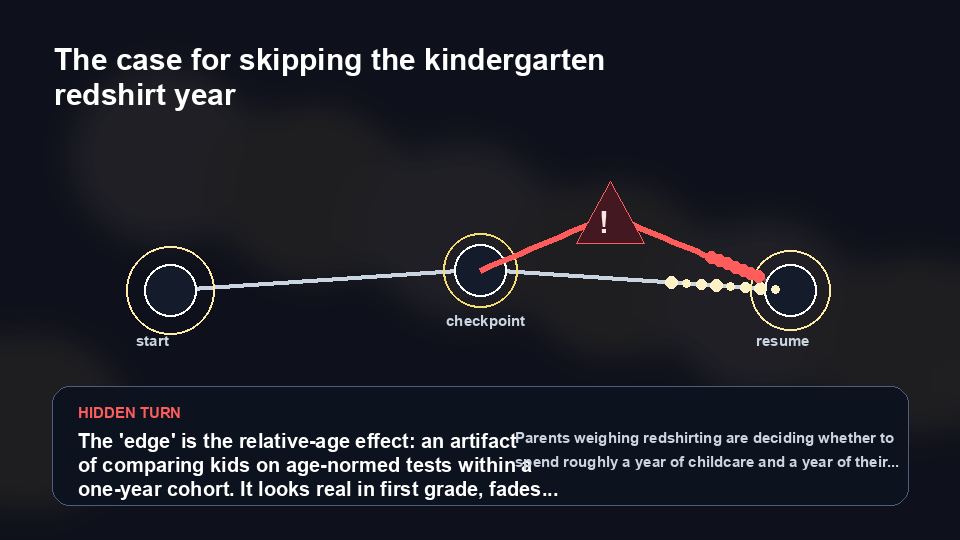
The image is doing the same work as this argument. The “advantage” parents are sprinting toward keeps sliding backward because every other family is also leaning into the blocks.
That’s not a metaphor problem — it’s the actual structure of the decision.
The verdict, up front: for a typically-developing kid, skip the redshirt year
Most readable articles on whether redshirting kindergarten is worth it end on a shrug — “talk to your pediatrician,” “trust your gut,” “every child is different.” That’s a comfortable answer, and it’s the wrong one for the family this question is usually being asked by.
The family asking is typically a college-educated, two-income household with a June, July, or August baby who is hitting all developmental milestones and could reasonably start on time. For that family, the honest answer is start on time.
The hedged framing flatters the upper-middle-class consensus around “the gift of time.” It also lets writers avoid an inconvenient body of evidence: the labor economists who have actually tried to measure the long-run effect of redshirting find a benefit that shrinks year after year and, on some outcomes, flips negative. The kids who get the visible boost in first grade are not the same kids whose adult lives turn out measurably better.
What parents are actually buying is the relative-age effect
The “relative-age effect” is the technical name for what redshirting buys. Inside any one-year kindergarten cohort, the oldest kids — born just after the cutoff — are 20% older in lived experience than the youngest.
Five-year-olds compared to six-year-olds will, on average, sit longer, read sooner, and follow multi-step directions more reliably. Teachers see that. Age-normed assessments magnify it. The child looks “ahead.”
A related write-up: how the maternal brain rewires.
The same effect shows up across age-banded systems everywhere. Canadian hockey rosters are famously stacked with January and February birthdays because of a December 31 cutoff.
Bedard and Dhuey’s NBER working paper on the persistence of early childhood maturity documented the analogous pattern in academic settings across OECD countries: at age 10, the oldest fourth of a cohort tests meaningfully ahead of the youngest fourth. The gap is real at age 10. The question is what happens after.
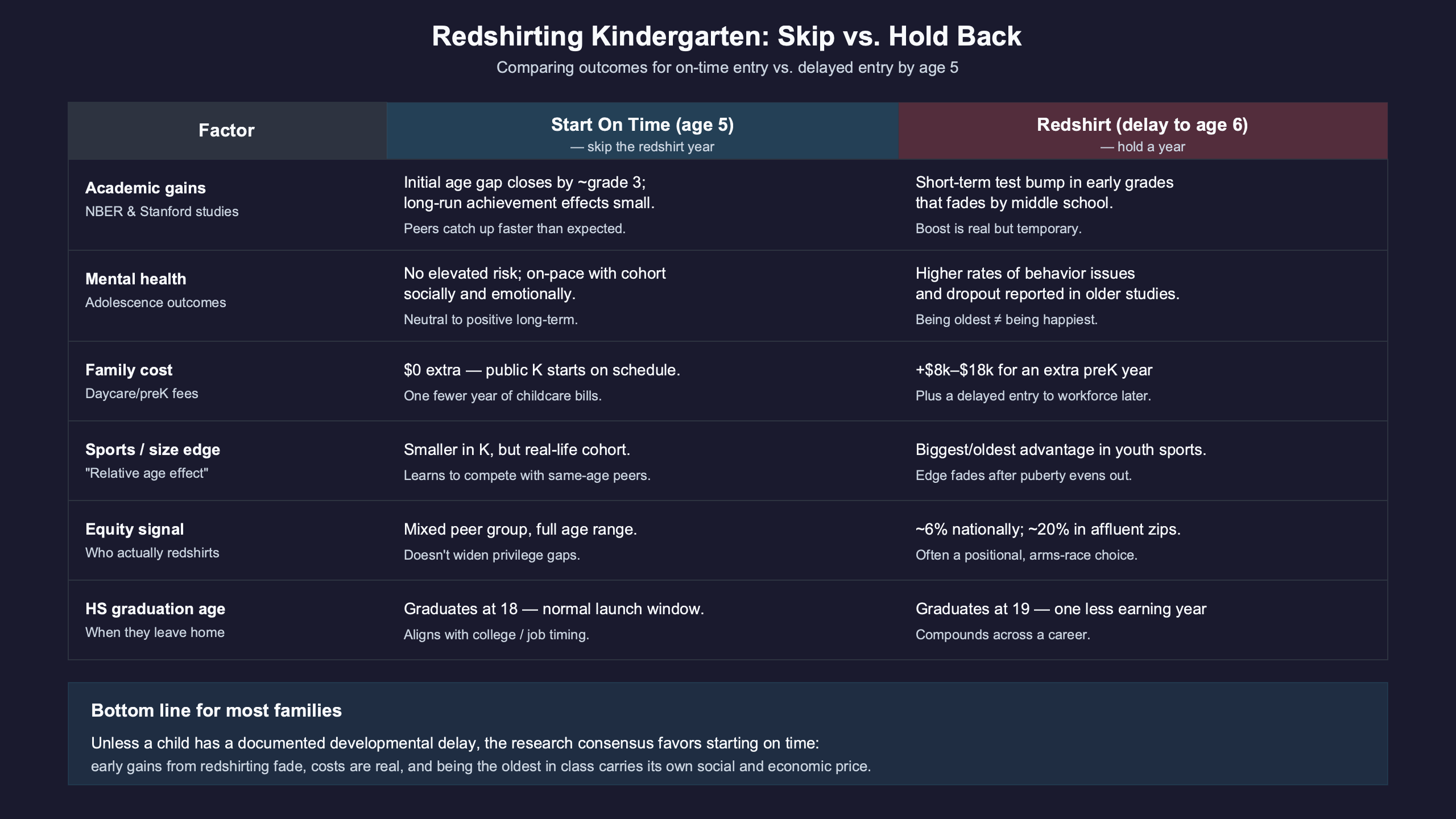
The diagram above lays out the mechanism in one frame: an age-normed test inside a one-year cohort will always produce a measurable spread, even if the underlying rate of skill growth is identical for every child. The “advantage” is being manufactured by the comparison group, not by the kid.
That’s why two kids with the same developmental trajectory can post very different kindergarten percentiles depending only on which side of the cutoff their birthday lands.
The fade-out: why the kindergarten edge collapses by middle school
The decisive evidence — and the literature the typical parenting article ignores — comes from Elder and Lubotsky’s 2009 paper in the Journal of Human Resources. Using ECLS-K longitudinal data, they tracked academic gaps between the oldest and youngest kindergarteners over time.
The gap was large at school entry, smaller by third grade, and effectively gone by eighth grade. The mechanism was straightforward: a six-year-old who knows more letters than a five-year-old is mostly demonstrating a year of additional life, not a year of additional school.
how developmental windows actually close goes into the specifics of this.
Other economists have replicated the fade-out and added a twist:
- Cascio and Schanzenbach (NBER): found short-run test gains for older entrants, but no detectable boost in long-run educational attainment for the marginal redshirted child.
- Bedard and Dhuey (Quarterly Journal of Economics): older school starters had modestly higher test scores, but the labor-market picture was mixed — and a later year of school entry mechanically meant a later year of labor-market entry, eating directly into lifetime earnings.
So the trajectory looks like this: a real bump in early elementary, a shrinking edge through middle school, a roughly neutral wash on academic outcomes by high school, and a small but persistent negative on the income side from entering the workforce a year late and retiring with one fewer year of compounded contributions.
The price tag nobody quotes
The honest cost-benefit comparison the “trust your instincts” articles refuse to do has two big line items, and both have current dollar figures attached.
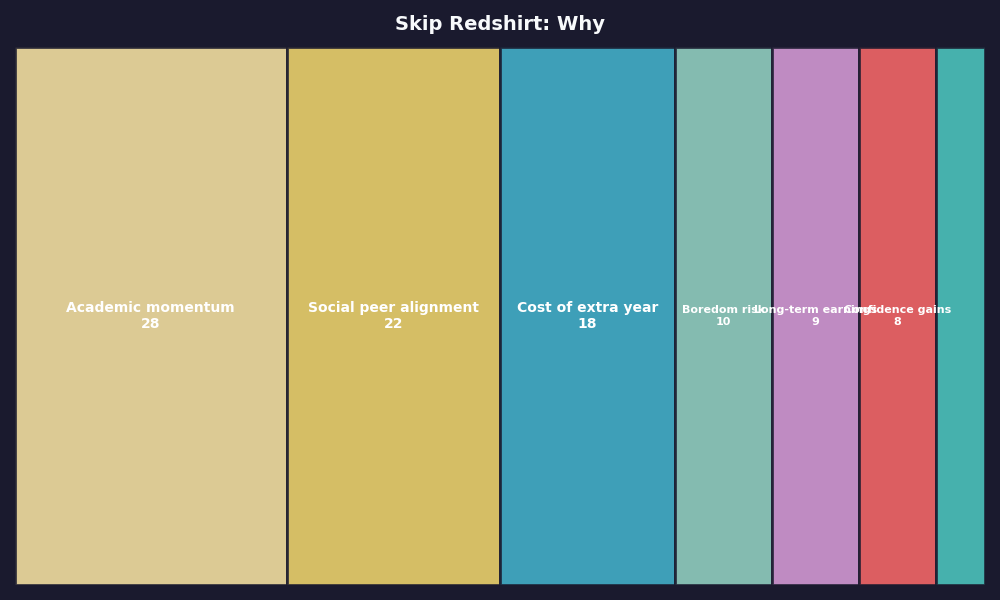
How Skip Redshirt: Why splits by category.
If you need more context, the real cost of a delayed earning year covers the same ground.
The breakdown above sketches the two costs side by side. The first is childcare: per the Child Care Aware 2024 Price of Care report, the national average for one year of center-based care for a preschool-age child sits in the $11,000–$17,000 range, with metro areas running well above that.
A pre-K program tuition runs in the same band. That money would otherwise be back in the household budget the moment kindergarten starts, because public K-5 is free.
The second is the foregone year of early-career earnings. BLS data on usual weekly earnings of full-time wage and salary workers puts median annual earnings for workers 25 to 34 above $50,000.
A redshirted child entering the workforce at 23 instead of 22 loses roughly one of those years on the back end, and — because of compounding — loses considerably more in retirement savings than the nominal salary number implies. None of this is hypothetical: the school-entry-age literature, including a Journal of Economic Perspectives review by Black, Devereux and Salvanes, treats the foregone year as a first-order cost of delayed entry.
| Dimension | Redshirt one year | Start on time |
|---|---|---|
| First-grade academic ranking | Higher (oldest in cohort) | Average to lower (youngest in cohort) |
| Eighth-grade academic ranking | Approximately equal | Approximately equal |
| Year of paid childcare added | $11,000–$17,000 (Child Care Aware 2024) | $0 (public K is free) |
| Workforce entry age | ~23 | ~22 |
| Path to a free IDEA Part B evaluation | School-based evaluation deferred unless parents separately request a district Child Find evaluation during the pre-K year | School-based evaluation available at enrollment; Child Find still requestable beforehand |
| Effect if widely adopted | Cutoff effectively shifts; advantage erodes | Stable baseline |
Source: Elder & Lubotsky (2009); Bedard & Dhuey (2006); Child Care Aware (2024); IDEA Part B regulations.
The positional-good problem: if everyone redshirts, no one redshirts
Redshirting is a positional good — its value depends entirely on other families not doing it. If half of August birthdays redshirt, the cohort’s effective median age slides up, and the next-oldest kids are now the “young” ones the redshirting was meant to avoid.
The cutoff has been moved, informally, by parental opt-out. The advantage doesn’t exist in absolute terms; it exists relative to whoever else showed up.
If you need more context, chasing optimisation without a payoff covers the same ground.
You can see the equilibrium happening already. Redshirting has been reported as more common in upper-income, college-educated households than in lower-income ones, with the practice often framed in parenting coverage as concentrated among families who can absorb the extra year of childcare.
When the practice concentrates in one demographic slice, the rest of the cohort effectively pays a relative penalty without ever opting in. That’s the game-theory shape parenting articles avoid: the “edge” is real for your kid only as long as the family next door declines to buy the same edge.
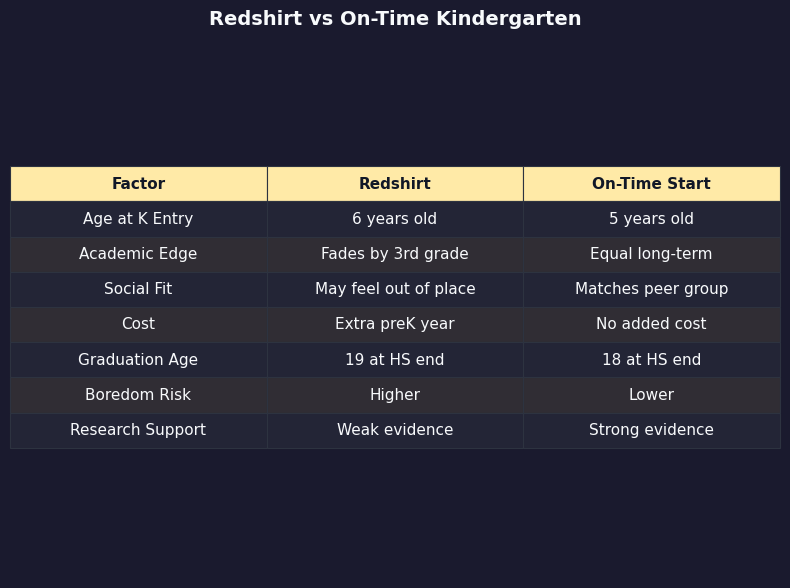
The comparison frame above keeps the two paths honest. Redshirt and you win the first-grade race; start on time and you save the childcare year, claim the earnings year, and lose nothing measurable on the long-run academic side.
The strongest counter-argument
The best good-faith objection to skipping the redshirt year is that the early-grade boost isn’t just a number on a percentile chart — it’s a felt experience for a five-year-old. The youngest kids in a kindergarten cohort really are sitting next to children who are visibly more verbal, more regulated, and more academically prepared, and Bedard and Dhuey’s Quarterly Journal of Economics analysis confirms the age-10 gap is large enough to be measured cleanly.
A child who spends those formative years feeling like the one who can’t keep up, the argument goes, might internalize a “struggling student” self-image that compounds for years — and no fade-out study can capture what that does to a kid’s relationship with school. Buying a year of being on the comfortable side of the cohort, in that frame, looks less like gaming a queue and more like a confidence intervention.
when the obvious lever isn’t the right one goes into the specifics of this.
The honest rebuttal is that the longitudinal evidence we already have is exactly the data this argument needs and doesn’t get. If a “confidence compounds” mechanism were real and durable, we would see it in Elder and Lubotsky’s eighth-grade tracking (Journal of Human Resources, 2009) and in Cascio and Schanzenbach’s long-run attainment numbers (NBER) — and we don’t.
Cascio and Schanzenbach specifically found no detectable boost in long-run educational attainment for the marginal redshirted child, which is the outcome a self-image effect would actually move. The early-grade discomfort is real; what the evidence rejects is the claim that surviving it leaves a lasting academic scar in typically-developing kids.
The counter-argument also collapses against the positional-good problem already laid out above. As more upper-income families redshirt, the youngest kids in the cohort are increasingly the children of families who couldn’t or didn’t opt in — meaning the “confidence intervention” any one family buys is paid for, in relative terms, by someone else’s kid.
And if the worry is genuinely about readiness rather than ranking, families don’t have to wait until kindergarten enrollment to access an evaluation. IDEA Part B Child Find (34 CFR §300.111) obligates the local district to identify and evaluate children with suspected disabilities, including preschool-age children who haven’t yet enrolled, and parents can contact the district directly to request that evaluation. A year of generic pre-K with no evaluation request swaps a documented assessment for a deferred one, which is the opposite of what a confidence-protective parent should want.
Three cases where delay actually is the right call
None of this argues against ever delaying kindergarten. There are three situations where waiting a year is the correct decision, and they look nothing like the strategic redshirt:
A diagnosed developmental delay. If a pediatrician, developmental specialist, or early-intervention evaluator has identified a delay that meaningfully affects readiness — speech, motor, social-emotional, sensory — and recommends additional support before formal schooling, delay paired with services is appropriate.
A related write-up: why intuitive fixes often backfire.
The American Academy of Pediatrics’ clinical report on the pediatrician’s role in optimizing school readiness frames delay-with-services (not delay alone) as the supported pathway when a readiness concern is flagged. The CDC’s Learn the Signs. Act Early. milestone tracker is the official screening reference families and providers use to decide whether a flag is warranted in the first place. The key is “paired with services,” not delay alone.
A documented academic-readiness gap with school sign-off. If a kindergarten screening, an ECE teacher’s structured observation, or a school district readiness assessment flags a specific skill gap, and the receiving school agrees that an additional year of pre-K with targeted curriculum would close it, that’s a defensible delay. The signal here is the school saying so, not the parent.
A serious medical or anxiety circumstance. A child recovering from extended hospitalization, significant sensory regulation challenges, or marked separation-anxiety difficulty may, in coordination with their pediatric care team, benefit from a year of stabilization before formal schooling.
The American Academy of Pediatrics’ clinical report on the pediatrician’s role in optimizing school readiness describes medical or psychosocial complications as one of the narrow categories where coordinated delay is clinically supported — not as a routine option for any nervous five-year-old. Again, this is qualitatively different from “I want my August boy to be tall for sports.”
The IEP trap: delaying enrollment can delay the school-based evaluation
Here’s the part the developmental-philosophy articles skip — with one important nuance most of them get wrong in the other direction. Under IDEA Part B’s Child Find requirement (34 CFR §300.111), every local education agency is obligated to identify, locate, and evaluate children with suspected disabilities.
That obligation explicitly extends to preschool-age children and to children who have not yet enrolled in kindergarten, which means a family that suspects a delay does not have to wait for the first day of school to get an evaluation. Parents can contact their school district during the pre-K year and request a Child Find evaluation; if the child is found eligible, the resulting Individualized Education Program and the services attached are free to the family.
The trap, then, is not enrollment itself — it’s silent delay. A family that redshirts and never requests a district evaluation is, in practice, postponing the very assessment that would have answered the readiness question and triggered services.
Pre-K programs vary wildly in whether they offer comparable evaluation pipelines; the public school system’s Child Find obligation does not. A parent whose child would have qualified for speech therapy, occupational therapy, or a structured social-emotional plan starting in September is, if they neither enroll nor request a district evaluation, getting another year of generic pre-K and the same diagnostic uncertainty.
The CDC’s Learn the Signs. Act Early. program is explicit that earlier identification of developmental concerns produces better outcomes than waiting. If the suspicion turns out to be right, that year is lost.
The fix is straightforward: if you’re delaying enrollment and there’s any readiness concern, put the Child Find request in writing to the district during the pre-K year rather than waiting on the calendar.
A four-question decision rubric parents can actually use
Ask these four questions, in order. Each one should get a clear yes or no.
- Has a pediatrician, developmental specialist, or school-district screener identified a specific delay or readiness gap? If yes, the conversation isn’t “redshirt or not” — it’s “delay plus what services,” and the request for a district Child Find evaluation should go in this year, not next. The CDC’s Learn the Signs. Act Early. milestone checklists are the standard reference for whether a concern actually warrants a flag. If no, move on.
- Does the receiving school’s kindergarten team recommend an extra year based on their own assessment? Their judgment is more useful here than a parent’s pattern-matching against an older cousin. If they say start, start.
- Can the household absorb another year of pre-K or childcare costs without strain, and have you accounted for the eventual year of lost early-career earnings? If the answer is “we’ll make it work because it matters,” ask why it matters — and whether the answer is a documented need or a status anxiety.
- If every family in your district made the same choice, would the advantage you’re chasing still exist? If the honest answer is no, you’re not buying a developmental benefit. You’re buying a temporary position in a queue that resets.
Three “no” answers means start on time. One clear “yes” on questions one or two means delay paired with services, not strategic delay. A “yes” on three or four alone is not a developmental reason — it’s a financial or competitive one, and neither survives the fade-out evidence.
If you need more context, a rubric that survives scrutiny covers the same ground.
The short version: if your kid is hitting milestones, the school is willing to take them, and the only argument for waiting is that they’ll be older than the youngest kids in class, the relative-age effect is doing the talking — and the relative-age effect doesn’t follow anyone to adulthood. Start on time, save the childcare year, and bank the earnings year on the other end.
Is redshirting kindergarten worth it for a summer birthday boy?
For a typically-developing summer-birthday child without a diagnosed delay, no. The first-grade advantage you’re chasing is the relative-age effect, and Elder & Lubotsky’s ECLS-K analysis shows it fades to roughly zero by eighth grade. You’d pay $11,000–$17,000 in extra childcare plus a year of foregone early-career earnings to rent an edge that resets the moment enough other families in your district make the same call.
Does redshirting hurt long-term academic outcomes?
It doesn’t durably help them, which is the relevant finding. Cascio and Schanzenbach’s NBER work found no detectable long-run boost in educational attainment for the marginal redshirted child, and the early-grade test-score lead fades through middle school. On the labor-market side, the later workforce entry mechanically costs one year of compounded earnings and retirement contributions — a small but persistent negative across a full career.
Can I still request an IEP evaluation if I delay kindergarten a year?
Yes, and you should put the request in writing during the pre-K year rather than waiting. Under IDEA Part B’s Child Find rule (34 CFR §300.111), local school districts must identify and evaluate children with suspected disabilities, including preschool-age kids who haven’t yet enrolled. The free school-based evaluation is available to you regardless of whether your child has started kindergarten.
How much does an extra year of preschool actually cost in 2026?
Center-based care for a preschool-age child runs roughly $11,000–$17,000 nationally per the Child Care Aware 2024 Price of Care report, with metro areas pushing well above that. That’s the direct line item families quote. The indirect cost is structural: the redshirted child enters the workforce around age 23 instead of 22, losing one year of compounded earnings and retirement contributions on the back end.
- Elder & Lubotsky, “Kindergarten Entrance Age and Children’s Achievement” (Journal of Human Resources, 2009) — the fade-out of relative-age academic gaps by 8th grade.
- Bedard & Dhuey, “The Persistence of Early Childhood Maturity” (QJE, 2006) — cross-country evidence on the long-run trajectory of school-entry age effects.
- Cascio & Schanzenbach, “First in the Class? Age and the Education Production Function” (NBER) — short-run test gains for older entrants, no long-run attainment boost.
- Child Care Aware of America, 2024 Price of Care report — national and state-level center-based childcare costs.
- IDEA Part B, 34 CFR §300.111 (Child Find) — district obligation to identify and evaluate children with suspected disabilities, including those not yet enrolled.
- American Academy of Pediatrics, “The Pediatrician’s Role in Optimizing School Readiness” — clinical guidance on delay paired with services versus routine delay.
- CDC, “Learn the Signs. Act Early.” developmental milestones — official screening reference for identifying readiness concerns.
- Education Commission of the States, kindergarten policy database — state cutoff dates and attendance requirements.
You may also like



Leave a Reply