
Inside Menopause Sleep: Hot Flashes, Core Temperature, and Bedding
Menopause sleep hot flashes are not only a “room is too warm” problem. A hot flash can trigger heat, sweating, and an awakening, but the harder sleep break often comes next: damp pajamas, trapped warmth in the mattress or comforter, then a cold rebound that keeps the brain alert. The practical goal is thermal recovery: reduce triggers, let heat escape, move moisture away from skin, and treat ongoing insomnia as its own sleep condition.
- Lower nocturnal hot flash frequency was linked with better PSQI sleep quality and less wakefulness after sleep onset.
- NIH sleep guidance treats CBT-I as a first-line option for long-term insomnia, usually delivered over 6 to 8 weeks.
- A “cool sheet” is not enough if the comforter, pajamas, or mattress topper trap sweat and delay drying.
Why Menopause Hot Flashes Wake You Up Twice
A menopause hot flash can wake you once through the vasomotor event itself, then again through the recovery mess it leaves behind. The first wake-up is heat, flushing, sweat, heart rate, and alarm. The second is bedding: damp fabric, sticky skin, a heat-holding mattress, or a comforter that felt cozy at 10 p.m. and clammy at 3 a.m.
The clinical term for hot flashes and night sweats is vasomotor symptoms. Mayo Clinic describes a hot flash as sudden warmth, often in the upper body, with sweating and sometimes chills as the episode lets up. That “sometimes chills” detail matters for sleep because the person is no longer only hot; she may now be awake, wet, and cold enough to pull the blanket back up, starting another heat trap.
If you need more context, hormonal brain changes covers the same ground.
The better question is not “How do I make the bedroom cold?” It is “How do I help the bed recover after a sweat?” A bedroom can be set to a sensible temperature and still fail if the sleep system holds moisture close to the body. Polyester pajamas, a dense memory foam topper, and a heavy down comforter can keep the microclimate around the body warm and damp even when the room air is cool.
This is why menopause sleep hot flashes need a different plan from ordinary summer overheating. A summer overheating fix might be a fan and lighter blanket. A menopause night-sweat fix has to handle repeated thermal swings: release heat quickly, absorb or move sweat, dry fast enough to prevent cold dampness, and let the sleeper adjust layers without fully waking.
The Core Temperature Trap: Hot, Sweaty, Then Too Cold
Sleep depends on temperature timing. The body normally prepares for sleep by shedding heat through the skin, while core temperature trends downward. During menopause, the thermoregulatory system can react to smaller shifts, producing a hot flash that forces heat release, sweating, and an awakening just when the brain should be staying quiet.
The hypothalamus is often described as the body’s heat manager. Mayo Clinic’s hot flash explanation says lower estrogen levels appear to make this system more sensitive to small body-temperature changes, starting a cooling response when the body is read as too warm. That response is useful in one narrow sense: sweating and blood-vessel changes release heat. It is bad for sleep because it can arrive abruptly and with enough body sensation to pull the sleeper into wakefulness.
The sequence usually feels like this: warmth rises through the chest, neck, or face; sweat appears; the sleeper throws off a blanket; the episode eases; sweat cools on the skin; then the same sleeper feels chilled and reaches for coverage. If the sheet and pajama fabric dry slowly, the cold stage can last longer than the hot flash. The brain has now received several wake signals: heat, wetness, movement, light if the person checks the time, and worry about whether sleep will return.
NIH-linked consumer information from NICHD notes that hot flashes can include sweating followed by shivering and may last from 30 seconds to 10 minutes. A short hot flash can therefore create a much longer sleep penalty when damp bedding makes the body keep correcting itself after the vasomotor event has passed.
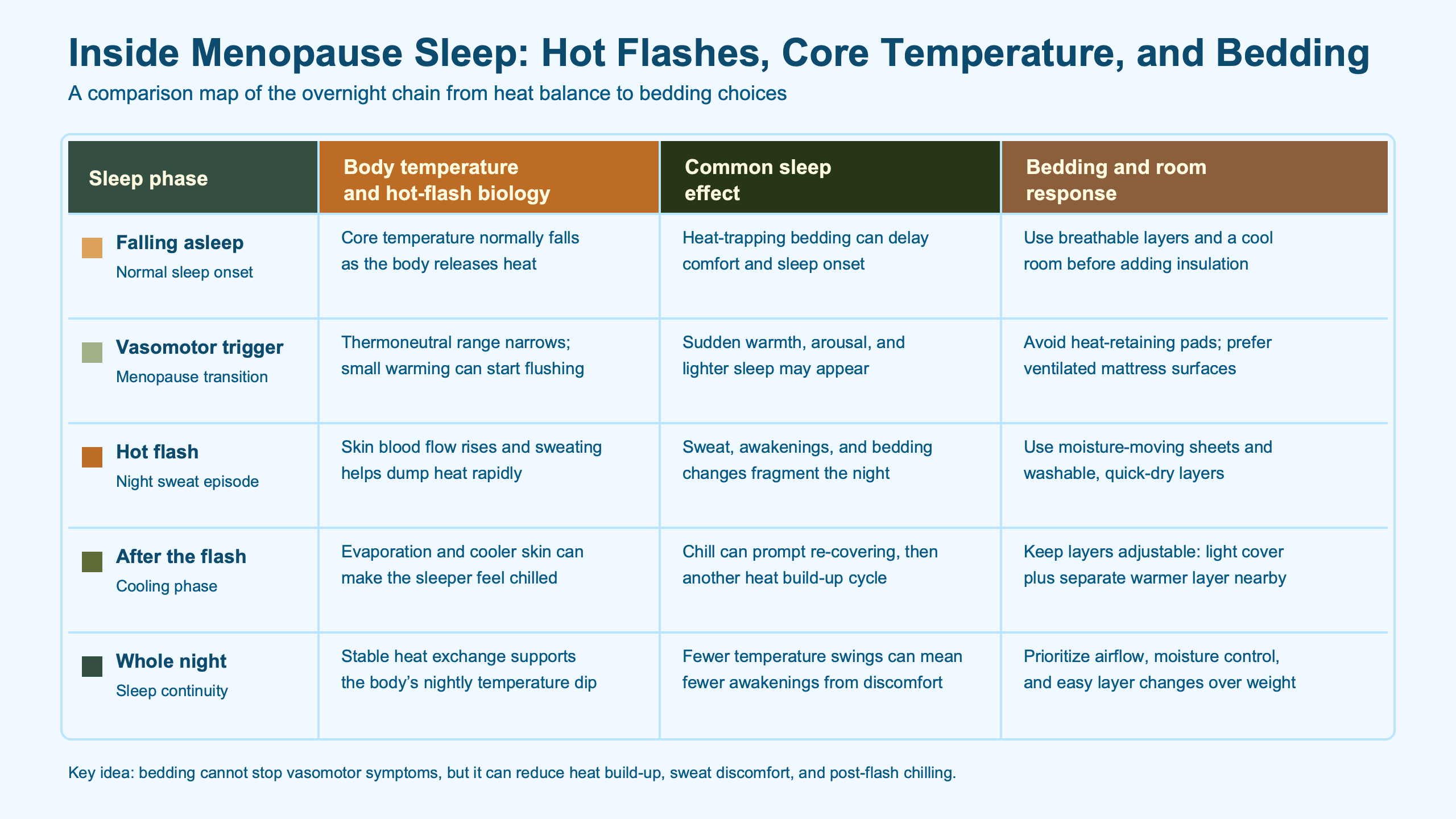
The useful reading of this diagram is the order of events. Core temperature regulation starts the episode, skin temperature and sweat do the cooling work, and bedding determines whether the sleeper returns to neutral or gets stuck in a hot-wet-cold loop. That last step is where home changes can help most.
A room that is too warm still matters. Alcohol, late spicy meals, heavy blankets, and a heated bedroom can increase the chance of a hot flash or make one more intense for some people. But the common advice to keep the bedroom “comfortable” is too vague for someone waking drenched. Comfort at bedtime is not the test. Recovery at 3 a.m. is the test.
What The Newer Sleep Data Actually Shows
The trial, reported in Hot flashes and sleep disruption in a randomized trial in menopausal women, enrolled 141 menopausal women assigned to continuous nitroglycerin or placebo. Hot flashes were the most common reported cause of waking.
Over 5 and 12 weeks, nocturnal hot flashes causing awakenings fell in both groups: 0.9 fewer episodes per night with nitroglycerin and 1.0 fewer with placebo. Wake after sleep onset, often shortened to WASO, also improved: 10.1 fewer minutes in the nitroglycerin group and 7.3 fewer minutes in placebo. PSQI sleep-quality scores improved by 1.3 points and 1.2 points, respectively. The between-group sleep differences were not statistically significant.
If you need more context, messy sleep data covers the same ground.
The part that helps readers most is the association across the combined sample. Greater improvement in nocturnal hot flash frequency was linked with better PSQI sleep quality, with beta = -0.30 and P = .01, and less WASO, with beta = -1.88 and P = .02. In plain terms, women whose night hot flashes improved more also tended to report better sleep and less time awake after falling asleep.
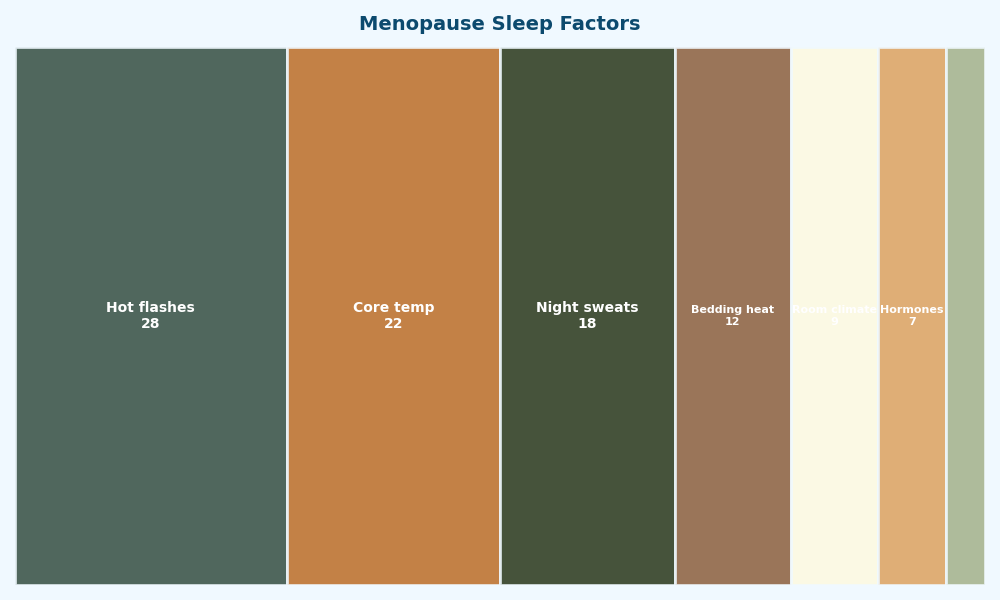
Share of each category in Menopause Sleep Factors.
The factor breakdown should be read as a set of overlapping causes, not a single blame chart. Vasomotor symptoms can start the awakening, bedding can extend it, and insomnia can keep the nervous system alert after the body has cooled. Good care separates those parts instead of treating every 3 a.m. wake-up as the same problem.
Older physiology work points in the same direction. In a controlled menopause model using a gonadotropin-releasing hormone agonist, the SLEEP journal study on nocturnal vasomotor symptoms and objective sleep found that reported nighttime vasomotor symptoms were associated with more sleep fragmentation, including greater polysomnography-measured WASO. The sample was small and younger than a typical natural-menopause group, but it showed a mechanism: more nighttime vasomotor symptoms can mean more objective wakefulness.
Mood data adds another warning against a one-cause story. In the 2011 Journal of Clinical Endocrinology & Metabolism trial, 72 peri- and postmenopausal women with depressive disorders, hot flashes, and sleep disturbance were randomized to transdermal 17β-estradiol, zolpidem, or placebo for 8 weeks. The primary mood outcome was change in Montgomery-Asberg Depression Rating Scale score. Improved sleep quality and increased estradiol predicted mood improvement; reduced hot flashes did not. That does not mean hot flashes are harmless. It means sleep itself can be a treatment target, not merely a symptom waiting for hot flashes to disappear.
Bedding Is Part Of The Treatment Environment
Bedding cannot treat the underlying vasomotor biology of menopause, but it can change the recovery environment after a hot flash. The right sleep setup reduces heat retention, moves moisture away from the skin, limits cold damp rebound, and makes layer changes possible without turning on lights or fully waking.
Evaluation basis: common bedding inputs readers can buy or already own were compared against current clinical sleep findings, plus material behavior that can be observed at home: breathability, drying speed, insulation, and washability. The list includes only bedding categories likely to appear in a typical household. The limitation is that sheets and comforters vary by weave, fill weight, brand, and laundry treatment, so the matrix is a decision aid, not a lab ranking.
For more on this, see healthier home environment.
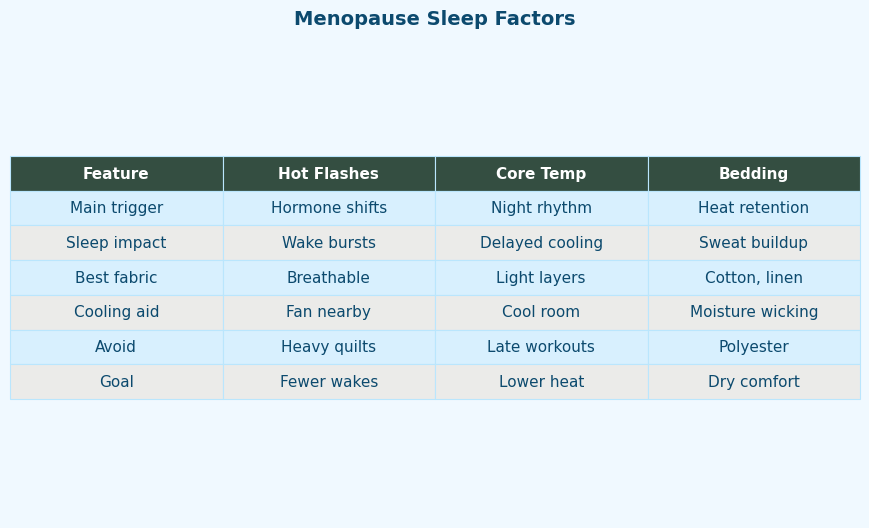
Differences at a glance — Menopause Sleep Factors.
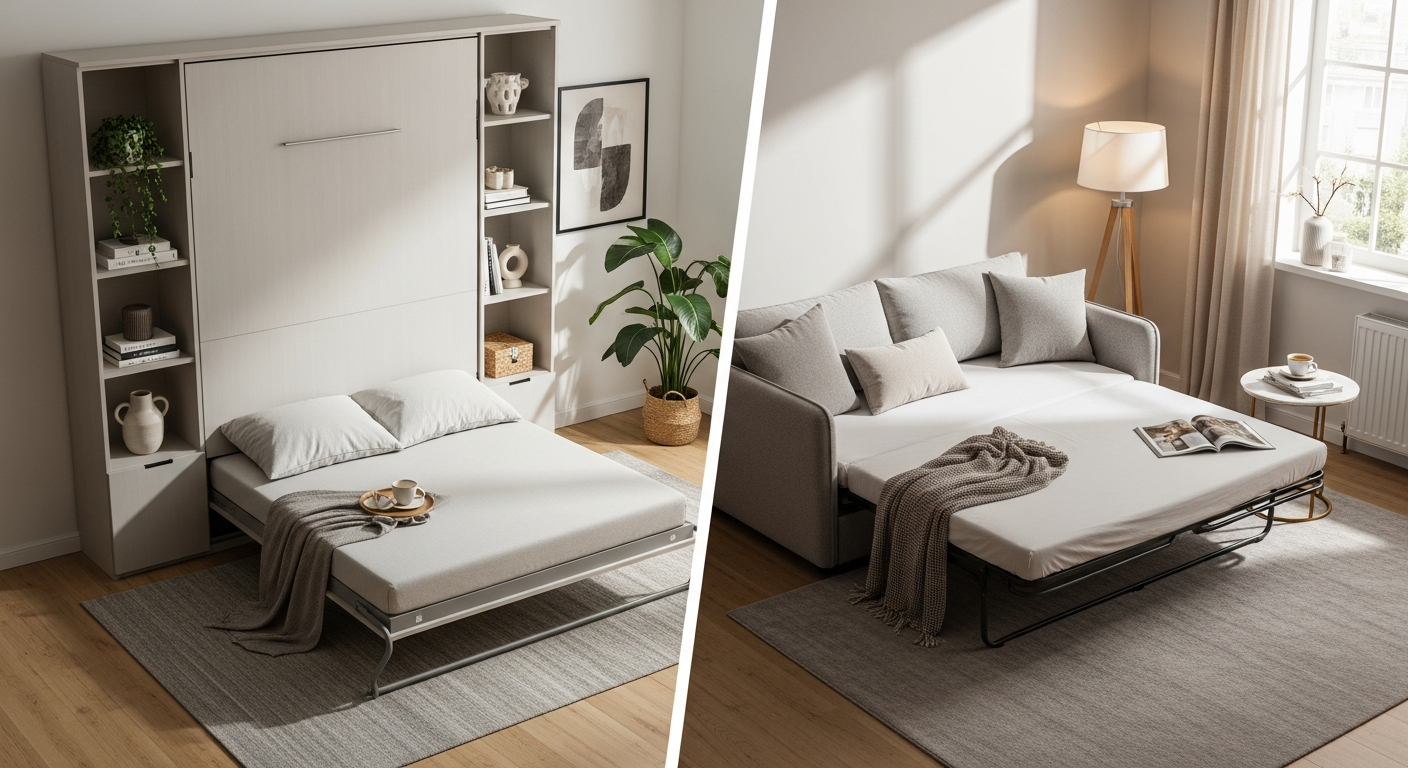
The comparison image is useful because it keeps the focus on the whole bed, not the sheet alone. A breathable top sheet can still fail under a heat-heavy comforter, and moisture-wicking pajamas can still feel clammy on a dense foam surface. Menopause sleep hot flashes need the layers to work together.
| Bedding input | Heat retention risk | Moisture handling | Cold-damp rebound risk | Best use case |
|---|---|---|---|---|
| Cotton percale sheet | Low to moderate, depending on thread count | Absorbs sweat but may stay damp if soaked | Moderate after drenching sweats | Good first swap for people using sateen or microfiber sheets |
| Linen sheet | Low | Absorbs and releases moisture well, with an airy feel | Lower than heavy cotton when the room has airflow | Frequent warm awakenings with moderate sweating |
| Bamboo/viscose sheet | Low to moderate | Often feels cool and drapes closely; drying varies by weave | Moderate if the fabric clings when wet | Hot sleepers who dislike crisp cotton and want a softer hand |
| Polyester microfiber sheet | Moderate to high | May feel slick but can trap heat and odor | High when sweat sits between skin and fabric | Usually a poor match for drenching night sweats |
| Down comforter | High if fill power or fill weight is high | Insulates well but can overwhelm heat release | Moderate, especially if paired with damp sheets | Cold rooms with rare sweating; not ideal for repeated hot flashes |
| Wool comforter | Moderate, depending on weight | Can buffer moisture better than many synthetic fills | Lower than down for some sweaty sleepers | Shared beds where warmth is needed without heavy clamminess |
| Memory foam mattress topper | High | Poor airflow unless specially designed and well ventilated | High because heat and sweat stay close to the body | Pressure relief only when heat is controlled by other layers |
The matrix points to a practical rule: remove the highest heat-retention layer before buying more “cooling” products. If a sleeper uses microfiber sheets, polyester pajamas, a dense foam topper, and a lofty down comforter, changing only the pillowcase will not move the system much. Start with the layer closest to the skin, then the layer that traps the most heat, then the mattress surface.
For sheets, crisp cotton percale and linen are usually more forgiving than polyester microfiber during night sweats because they allow more air movement and do not create the same slick, sealed feeling. Bamboo or viscose sheets can feel cool at first touch, but the weave and finish matter; a clingy sheet can become uncomfortable when wet. For comforters, a lighter washable quilt, a wool-filled comforter, or two thinner blankets often gives more control than one heavy duvet.
Pajamas count as bedding because they are the first moisture layer. Loose cotton, linen, merino, or well-designed performance sleepwear can work, but the deciding factor is whether the fabric dries without chilling the skin. Tight leggings, thick synthetic fleece, and non-breathable sleep bras often hold sweat in the wrong place. Keep a dry top within reach if drenching sweats are common; changing one layer in the dark is less disruptive than changing the whole bed.
A Pick-This-If Bedding Framework
Use this decision framework from the body outward: first pick the fabric touching your skin, then choose the cover strategy, then decide whether the mattress surface is sabotaging recovery. The right choice is the one that solves the specific failure you notice at 3 a.m., not the one marketed as generically “cooling.”
| Pick or choose this | If this is your pattern | Why it helps |
|---|---|---|
| Pick cotton percale | Your current sheets are microfiber, sateen, slick, or sealed-feeling when damp. | It is an easy first swap that improves airflow and reduces the trapped-sweat feeling for many sleepers. |
| Choose linen | You wake warm and sweaty but not always fully drenched. | It gives more airflow and releases moisture well, especially with some room ventilation. |
| Choose bamboo or viscose cautiously | You want a soft, drapey sheet and dislike crisp cotton. | It can feel cool at first, but it is only a good fit if it does not cling when wet. |
| Pick a light quilt or two thin blankets | You keep throwing covers off, then pulling them back on after the sweat cools. | Separate layers let you vent heat without losing all warmth at once. |
| Choose wool fill | You need warmth in a shared or cool room but get clammy under down or polyester fill. | Wool can buffer moisture better than many heavy synthetic or down layers. |
| Remove or replace dense memory foam | The heat seems to come from underneath, or your back and hips stay warm even with light sheets. | The mattress surface may be trapping heat and sweat where sheets cannot fully fix it. |
| Use washable absorbent layers | Sweats soak the bed, not just your sleep shirt. | They protect the mattress and make cleanup less disruptive, as long as they are breathable. |
| Use split blankets | One partner is cold while the other has hot flashes. | Each person gets a separate thermal zone instead of fighting over one shared duvet. |
| Use medical sleep help | Your body is dry and comfortable, but your brain stays awake for long stretches. | That pattern points beyond bedding toward insomnia treatment or another sleep condition. |
Read the table as a way to diagnose the weakest point in the bed, not as a shopping list. If the problem starts with clammy fabric against the skin, the sheet and sleepwear matter most. If the pattern is covers on, covers off, then chilled again, the top layers need to be easier to vent in small steps. If heat seems to build from below, a dense foam surface may overpower any sheet change.
Texture preferences still count. Some sleepers do best with crisp, airy fabrics; others sleep better in a softer drape, provided it does not cling when wet. Warmth needs vary too, especially in shared beds, so split blankets or mixed cover weights can solve the temperature mismatch without forcing one person to sleep too hot or the other too cold.
When sweat reaches the mattress or forces a full bedding change, breathable washable protection becomes part of sleep preservation, not just cleanup. But if the body is dry, the bed feels comfortable, and wakefulness continues for long stretches, another fabric swap is unlikely to solve the main problem. That is the point to think about insomnia care or another sleep disorder rather than adding more bedding.
How To Tell Whether It Is A Hot Flash, A Hot Bed, Or Insomnia
The pattern of the wake-up tells you where to start. Waking hot before sweating points toward a vasomotor or environmental heat trigger. Waking already damp points toward a sweat-management problem. Waking alert without heat may be insomnia, stress arousal, nocturia, pain, sleep apnea, or another sleep disruptor.
| What you notice | Likely driver | First bedding change | Medical flag |
|---|---|---|---|
| Wakes hot before sweating | Vasomotor episode, warm room, heavy covers, alcohol, or late heat load | Use a lighter top layer and keep feet or one leg easier to uncover | Discuss treatment if hot flashes regularly disrupt sleep or daily life |
| Wakes already damp | Sweat occurred before full awareness; bedding is holding moisture | Swap microfiber or sateen for percale or linen; add a washable absorbent pad | Seek care if sweats are new, severe, unexplained, or not tied to menopause timing |
| Wakes cold after sweating | Evaporative cooling plus wet fabric against skin | Keep a dry pajama top nearby; use layers that can be peeled back separately | Ask about thyroid issues, infection, medication effects, or other causes if chills are marked |
| Partner is cold | Shared-bed temperature mismatch | Use separate blankets with different weights rather than one shared duvet | No flag by itself unless sweating is severe or paired with other symptoms |
| Sweats occur without heat sensation | May be non-menopause night sweats, medication effect, infection, reflux, or sleep apnea | Use washable, breathable layers while tracking timing and symptoms | Bring this to a clinician, especially with fever, weight loss, chest symptoms, or new medications |
This split prevents two common mistakes. The first is blaming the bed for every wake-up and buying product after product while untreated vasomotor symptoms continue. The second is blaming menopause for every wake-up and missing chronic insomnia, sleep apnea, pain, anxiety, bladder symptoms, reflux, or medication effects.
Johns Hopkins Medicine notes that many women feel a hot flash woke them, yet research has found that some awaken just before a hot flash. That point changes the plan. If the brain wakes first, then a hot flash follows, treating insomnia and reducing micro-awakenings may reduce the number of episodes a person remembers as hot-flash awakenings.
A two-week log is often enough to see the pattern. Track bedtime alcohol, spicy meals, room temperature, bedding used, awakenings, whether sweat came before or after waking, and how long it took to return to sleep. The log does not need to be perfect. It only has to show whether the main failure is heat onset, moisture recovery, or wakefulness that continues after the body is dry and comfortable.
Two Bedding Setups For Different Night-Sweat Patterns
The best bedding setup depends on the night-sweat pattern. A single sleeper with drenching sweats needs washable moisture control and fast layer changes. A shared bed with one hot sleeper and one cold sleeper needs separate thermal zones so one person’s treatment does not ruin the other person’s sleep.
Single sleeper with frequent drenching sweats
For a single sleeper who wakes soaked several nights a week, build the bed for damage control. Start with a breathable mattress protector that is quiet and washable, then add a thin cotton or wool mattress pad rather than a thick memory foam topper. Use a cotton percale or linen fitted sheet, a separate top sheet, and one light quilt or blanket that can be kicked away without dragging the whole bed apart.
The layer-by-layer configuration is simple: breathable protector, thin washable pad, percale or linen fitted sheet, loose moisture-tolerant sleep top, spare dry top within arm’s reach, top sheet, light quilt. Keep a second top sheet folded nearby if sweats are heavy enough to soak the first. The goal is not luxury; it is returning to sleep with the fewest decisions and the least light exposure.
Shared bed with one hot sleeper and one cold sleeper
For a couple with a temperature mismatch, stop trying to solve two bodies with one duvet. Use the same fitted sheet if both like it, but split the top layers. The hot sleeper gets a top sheet plus a thin quilt or wool throw. The cold sleeper gets a warmer blanket or down layer on their side only. If the bed size allows it, two twin-size comforters on a queen or king bed can feel calmer than one shared cover pulled back and forth all night.
The layer-by-layer configuration for this setup is: breathable protector, shared percale or linen fitted sheet, optional separate top sheets, hot sleeper’s light blanket, cold sleeper’s warmer comforter, no heavy shared duvet across both bodies. This also helps relationships. A person having night sweats can uncover, dry, or change a pajama top without leaving the partner cold and resentful.
When Sleep Hygiene Is Not Enough
Sleep hygiene helps, but it is not enough when hot flashes, chronic insomnia, mood symptoms, or new severe night sweats are driving the problem. Regular schedules, less late caffeine, and a darker room are useful basics. They do not replace clinical treatment for vasomotor symptoms or CBT-I for persistent insomnia.
The NHLBI insomnia treatment page describes CBT-I as a 6- to 8-week treatment that is usually recommended first for long-term insomnia. It can include cognitive therapy, relaxation or meditation therapy, sleep education, sleep restriction, and stimulus control. For menopause sleep hot flashes, CBT-I is especially relevant when the body has cooled but the mind stays awake, watches the clock, or starts fearing the next episode.
sleep health basics goes into the specifics of this.
The Menopause Society’s 2023 nonhormone therapy position statement also helps separate evidence from wishful thinking. It lists several recommended nonhormone options for vasomotor symptoms, including cognitive-behavioral therapy, clinical hypnosis, SSRIs/SNRIs, gabapentin, fezolinetant, and oxybutynin, with evidence levels noted in the statement. It does not treat cooling techniques, trigger avoidance, yoga, or mindfulness-based intervention as proven vasomotor treatments in the same way. Those practices may still help stress, fitness, and coping, but they should not be sold as a sure hot-flash cure.
| Input | Why it may backfire | When to discuss with a clinician |
|---|---|---|
| OTC sleep aids | Many contain antihistamines that can cause next-day grogginess and may be unsafe for some people. | If use is more than occasional, if falls or confusion occur, or if other medications are involved. |
| Alcohol before bed | It may shorten sleep onset but can make sleep lighter and increase awakenings later in the night. | If alcohol is being used as a sleep tool or night sweats are worse after drinking. |
| Persistent insomnia | Waiting for hot flashes to stop can let conditioned wakefulness become its own problem. | If trouble falling or staying asleep occurs at least 3 nights weekly and lasts months. |
| New or severe night sweats | Not every night sweat is menopause; medications, thyroid disease, infection, cancer treatment effects, and other conditions can play a role. | If sweats are new, soaking, paired with fever or weight loss, or occur without a heat sensation. |
Medical escalation is not a failure of self-care. It is the correct next step when hot flashes regularly damage sleep, when mood symptoms worsen, when daytime functioning drops, or when sweating changes suddenly. Hormone therapy, nonhormone medications, and insomnia treatments have different risk-benefit profiles; a clinician can match them to age, menopause timing, cancer history, cardiovascular risk, liver health, other medicines, and personal preference.
For home changes, start where the sleep break happens. If the first problem is heat, lighten covers and reduce evening triggers. If the second problem is dampness, change the fiber mix and layer design. If the third problem is lying awake after the body is comfortable again, treat insomnia directly. Menopause hot flashes may begin the night’s disruption, but the path back to sleep is often built in the minutes after the sweat.
wearable sleep trackers is a natural follow-up.
References
- Hot flashes and sleep disruption in a randomized trial in menopausal women
- Increased estradiol and improved sleep, but not hot flashes, predict enhanced mood during the menopausal transition, Journal of Clinical Endocrinology & Metabolism, 2011
- A gonadotropin-releasing hormone agonist model demonstrates that nocturnal hot flashes interrupt objective sleep, SLEEP, 2013
- The 2023 nonhormone therapy position statement of The North American Menopause Society
- NHLBI insomnia treatment guidance, including CBT-I and medication cautions
- NICHD menopause symptom information, including hot flashes and shivering after sweating
- Mayo Clinic hot flashes symptoms and causes
- Johns Hopkins Medicine sleep problems and menopause
You may also like


Leave a Reply