
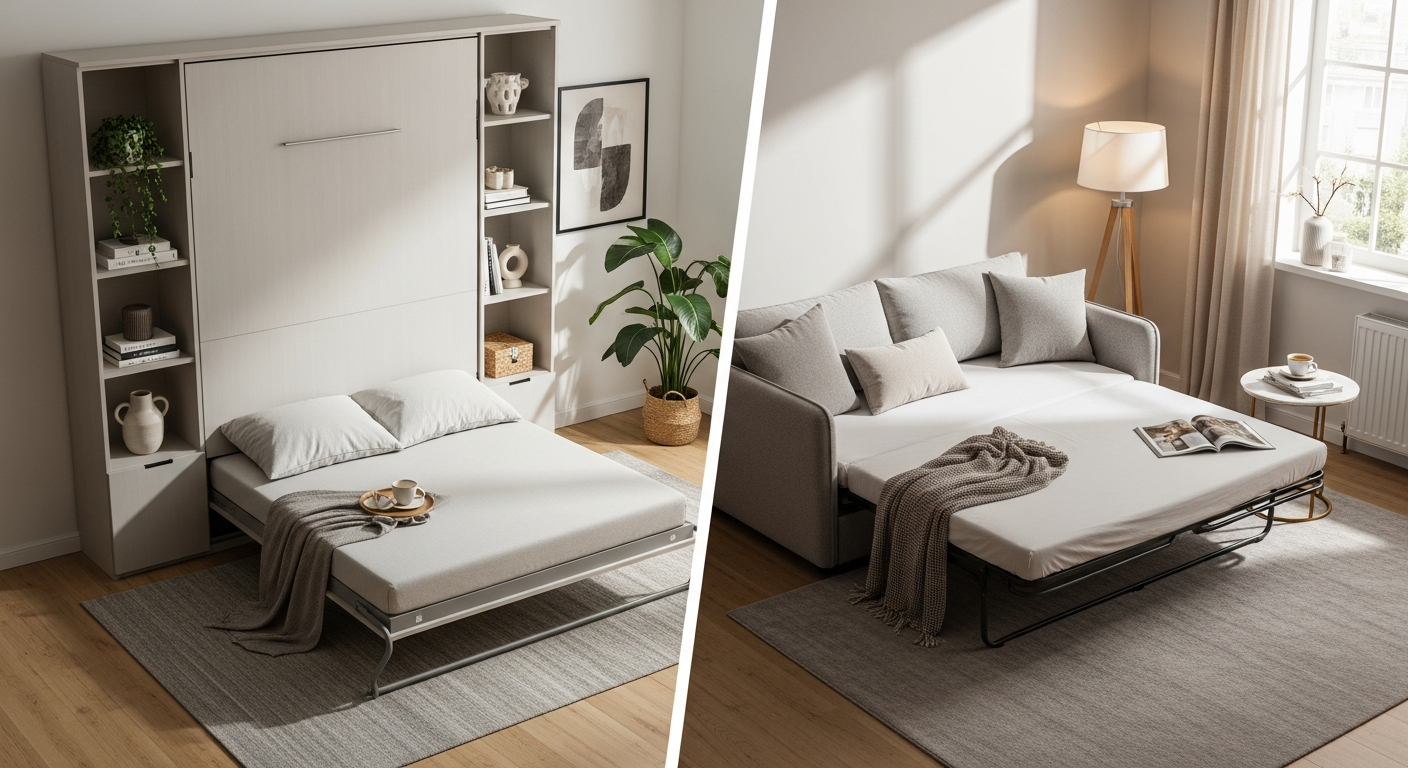
Murphy Bed vs Convertible Daybed for Studio Apartments: Floor Space, Guest Comfort, and Install Cost
The choice between a Murphy bed and a convertible daybed gets framed as a matter of taste in nearly every guide on the first page of Google results. It isn’t. It is a three-variable problem — studio square footage, guest-night frequency per year, and lease type — and the answer flips predictably based on those three inputs. Run the numbers honestly and the daybed wins for the majority of renters in studios under 400 square feet, and the Murphy wins in a much narrower band of cases than the vendor blogs suggest.
In this post
- The 70-word answer: which one wins for your studio?
- The floor-space math competitors skip
- What a Murphy bed actually costs to install in 2026
- The mattress-thickness ceiling is the guest-comfort ceiling
- The renter math: security deposits, wall types, and what you leave behind
- The decision rubric: square footage × guest-nights × lease type
- When the daybed-with-trundle quietly wins
- Edge cases where the rubric flips: owners, frequent hosts, and sub-300 sq ft micro-studios
The 70-word answer: which one wins for your studio?
If your studio is under 400 sq ft, you host fewer than 20 guest-nights a year, and you are renting on a lease shorter than three years, the convertible daybed wins on total cost of ownership. If your studio is between 400 and 600 sq ft with regular guests or a long-term lease (or you own), a queen Murphy bed pays back its install cost in floor area. Sub-300 sq ft micro-studios are an edge case where Murphy wins regardless of guest count.
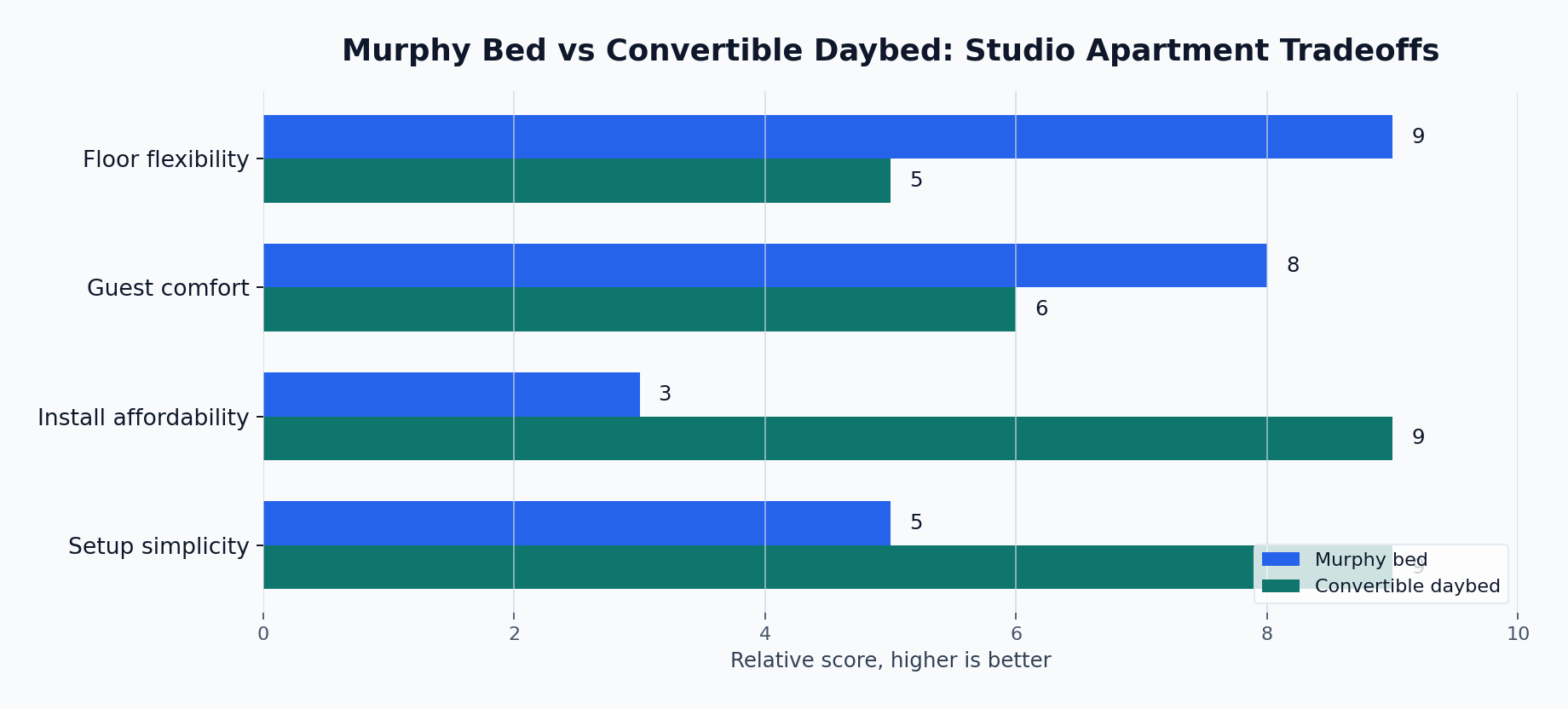
Readable score chart comparing floor flexibility, guest comfort, install affordability, and setup simplicity.
The benchmark above tracks the four dimensions where the two options actually diverge: deployed floor footprint, install cost, mattress ceiling, and resale value. The daybed’s footprint is permanent but small; the Murphy’s footprint is zero when stowed but punitive when deployed because the swing arc is empty space the rest of the room has to work around.
The floor-space math competitors skip
Vendor blogs love the phrase “frees up floor space” without ever quoting a number. Here is the number. A standard queen mattress is 60 by 80 inches, which is 33.3 sq ft. A queen Murphy cabinet sits on 16 to 22 inches of wall depth and roughly 70 inches of wall width — call it 11 sq ft of permanent footprint when stowed. Net deployed gain when the bed comes down: about 22 sq ft of floor you can use during the day.
In a 350 sq ft studio, that 22 sq ft is 6.3% of total floor — a meaningful but not transformative recovery. The catch is the swing arc. A wall-mounted queen Murphy needs an 80-inch length plus an 18-to-24-inch unobstructed corridor at the foot to deploy. Once you account for the corridor, the area you can actually furnish during the day shrinks back. Put a console table or a rug in that corridor and you cannot drop the bed without moving them every night.
I wrote about reclaiming small-space layouts if you want to dig deeper.
A typical convertible daybed with a twin-XL mattress (38 by 80 inches, or 21.1 sq ft) sits permanently in roughly 23 sq ft including the frame. The footprint never changes. You lose 23 sq ft permanently instead of 11 sq ft permanently plus a 22-sq-ft daily-deploy event with a clearance corridor.
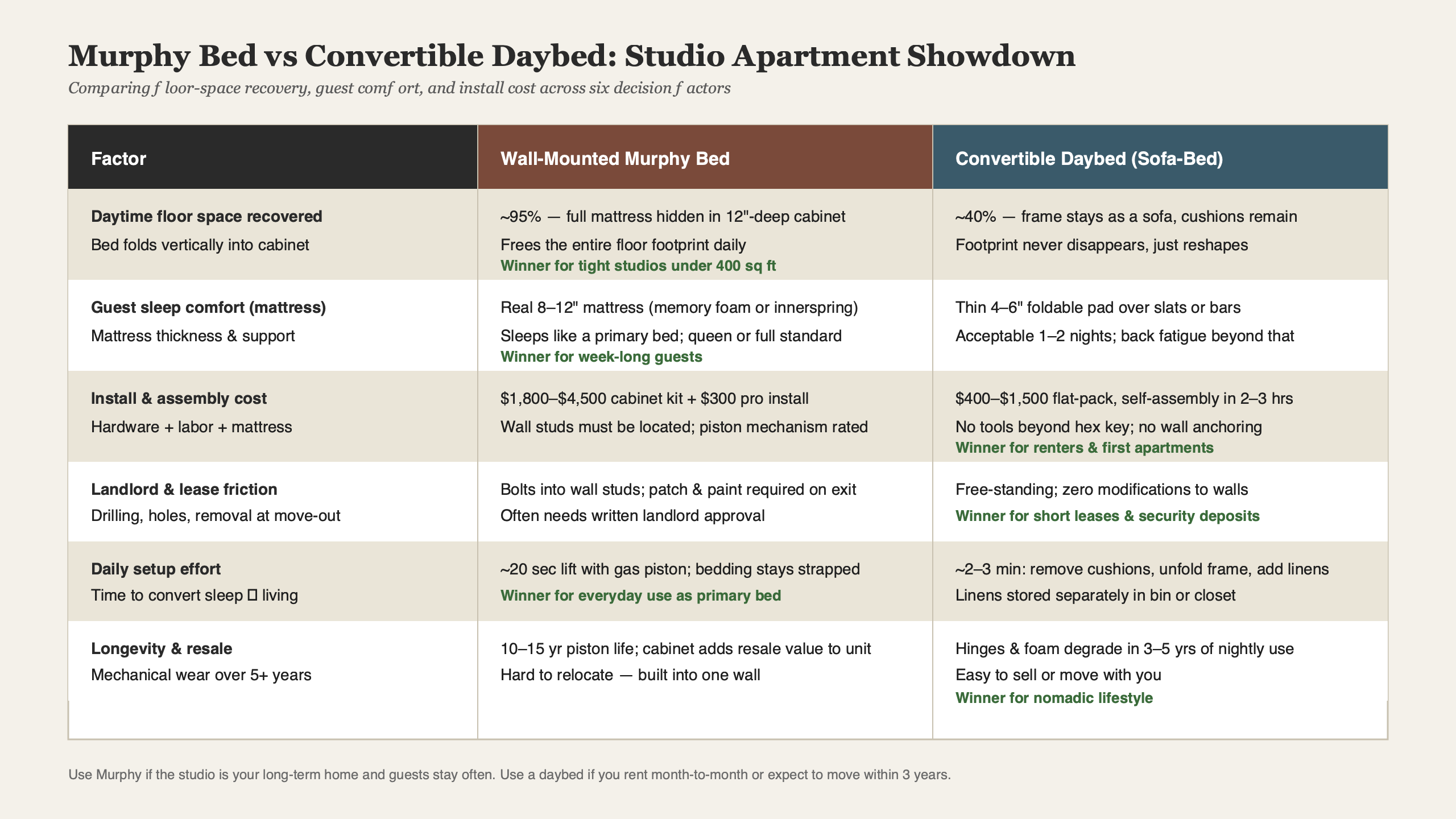
What a Murphy bed actually costs to install in 2026
“Murphy bed cost” is not one number. It is four line items, and only one of them appears prominently on retail product pages.
Cabinet kit: $1,200 to $4,500 retail for a queen vertical unit. IKEA does not currently sell a true wall-pivoting Murphy cabinet — the PLATSA system is a storage bed, not a Murphy mechanism. For a flat-pack Murphy you are looking at Bestar, Multimo, or a custom local cabinet shop.
A related write-up: wall treatment considerations.
Lift mechanism kit: $350 to $900. The mechanism is the spring or piston system that does the actual lifting, and it sells separately from the cabinet on the DIY market. Create-A-Bed’s adjustable queen kit and the Easy DIY Murphy Bed kits are the two reference products.
Mattress (with a hard ceiling): $400 to $1,500. Every major lift mechanism caps mattress thickness at 10 to 12 inches. Create-A-Bed’s FAQ states the maximum mattress thickness is 12 inches including the pillow top, with weight ranges of 65 to 80 lbs for queen and 30 to 50 lbs for twin. Heavier or thicker mattresses void the balance calibration.
Add the line items: a mid-range queen Murphy install lands at $2,500 to $4,200 all-in. A West Elm or Article queen daybed with twin trundle lands at $1,600 to $2,400 with no install, no anchoring, and a mattress ceiling set only by physics.
The mattress-thickness ceiling is the guest-comfort ceiling
Guest comfort is the dimension where the Murphy bed has a structural disadvantage that no amount of cabinet upgrading fixes. The lift mechanism balances against a counterweight calibrated to a specific mattress weight range. Exceed the range — too thick, too dense, or both — and the bed either won’t stay up or won’t come down without a fight.
The 12-inch ceiling matters because most contemporary hybrid and pillow-top mattresses run 13 to 15 inches. Casper’s Wave Hybrid, Saatva Classic, and the Tempur-Adapt LuxeBreeze all sit above the Murphy ceiling in their standard heights. You can buy a 10-inch foam mattress and call it good, but you have ruled out the entire premium hybrid category for guests.
Background on this in what sleep trackers reveal about mattress quality.
A standard daybed, by contrast, accepts any twin or twin-XL mattress between 8 and 14 inches with no compatibility issue. The trundle slot under most daybeds accepts a second twin mattress up to 8 inches thick, which sleeps an adult guest comfortably for short stays.
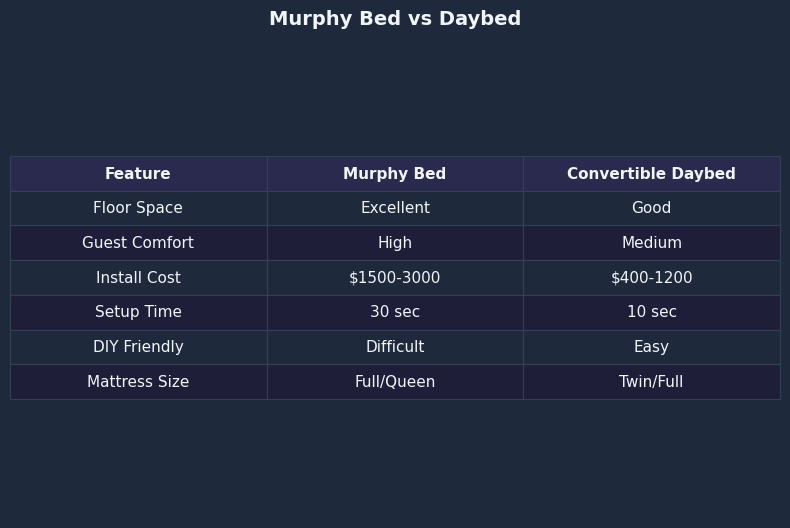
Feature comparison — Murphy Bed vs Daybed.
The comparison above lays out the mattress option set side by side. The Murphy column is short — a curated subset of foam and thin hybrid mattresses that meet both the thickness ceiling and the weight range. The daybed column is the full mattress aisle.
The renter math: security deposits, wall types, and what you leave behind
The vendor blog at the top of the SERP is selling Murphy beds, so it never addresses the structural risk to a renter’s security deposit. The risk is real and deserves its own column on the decision matrix.
A queen Murphy bed installs into a minimum of three wall studs with lag bolts rated for a dynamic load (the load while the bed is being folded and unfolded, not just static weight). When you move out, you leave behind a row of half-inch holes in studs and drywall that no patch kit fully hides. Most landlords code that as “alterations beyond ordinary wear and tear,” which is the exact language used to deduct from a security deposit.
I wrote about budgeting for big-ticket purchases if you want to dig deeper.
Wall type matters too. Plaster-and-lath walls, common in pre-war buildings, do not always have studs at predictable 16-inch spacing — and toggle bolts in plaster are not rated for dynamic Murphy loads. Steel-stud construction in newer high-rises requires self-tapping screws sized for the gauge of the stud, not standard wood lag bolts. If you have not confirmed your wall type before buying the cabinet, you do not yet know whether you can install at all.
Daybeds, by contrast, are furniture. They sit on the floor. You move them out the same way you moved them in, and the resale market is broad: a quick scan of Facebook Marketplace in any major metro shows hundreds of West Elm, Crate & Barrel, and Article daybeds reselling for 40 to 65% of original retail. Custom Murphy installations are nearly impossible to resell because the cabinet is built to a specific wall location and the buyer has to remove and re-anchor it.
The decision rubric: square footage × guest-nights × lease type
This is the table no other guide on the SERP publishes. Run your studio through it and you get a recommendation, not a shrug.
| Studio size | Guest-nights/year | Lease/ownership | Recommended |
|---|---|---|---|
| Under 300 sq ft | Any | Any | Murphy queen — floor space dominates |
| 300–400 sq ft | Under 20 | Renter, 1–2 yr lease | Daybed with trundle |
| 300–400 sq ft | Under 20 | Owner or 5+ yr lease | Murphy queen |
| 300–400 sq ft | 20+ | Any | Murphy queen |
| 400–600 sq ft | Under 10 | Renter | Daybed (full or queen) |
| 400–600 sq ft | 10+ | Any | Murphy queen |
| Over 600 sq ft | Any | Any | Standard bed; the question doesn’t apply |
How this rubric was built: the breakpoints come from three inputs. Square-footage thresholds at 300 and 400 sq ft mark the points where the Murphy’s 22-sq-ft daily floor recovery crosses 7% and 5% of total floor area, respectively — the rough threshold below which dual-purpose furniture stops feeling optional. The 20-guest-night/year threshold is the point where the daybed trundle’s setup-and-strip burden exceeds 30 minutes per week averaged across the year. The lease threshold reflects payback math: at $2,000 of net Murphy install cost above a comparable daybed, a 5-year horizon brings the per-month premium under $35, which is roughly the value of one extra weekend day per month at home.
See also securing a rental unit.
When the daybed-with-trundle quietly wins
For a renter in a 350 sq ft studio hosting fewer than 20 guest-nights a year, the trundle delivers nearly identical sleep capacity to a queen Murphy at half the all-in cost, with no anchoring, no security-deposit risk, and resale value that survives a move. The trundle’s only real losses are bed height for the host (most trundles top out at 26 inches deck height versus a standard 16-inch queen Murphy deck) and the slight inconvenience of pulling the trundle out — about 30 seconds.
Edge cases where the rubric flips: owners, frequent hosts, and sub-300 sq ft micro-studios
The Murphy is genuinely the right answer in a few clear cases, and the article would be dishonest not to flag them. If you own your studio, the wall holes are not a deposit issue and the install cost amortizes over a longer horizon. If you host more than 20 guest-nights a year, the daily setup-and-strip of a daybed-as-bed becomes a real friction tax. And below 300 sq ft — the territory of converted micro-studios in San Francisco and parts of Brooklyn — the daybed’s permanent 23 sq ft consumes too much of the room. At that scale the Murphy bed’s daily-deploy floor recovery goes from a nice-to-have to load-bearing.
The other genuine Murphy case is the work-from-home studio where the day uses are non-negotiable. A 350 sq ft studio with a desk, a meeting setup, and a small couch cannot also accommodate a permanent daybed without making the work setup feel cramped on every video call. In that scenario the Murphy buys back the day for work and gives the night back for sleep, and the install cost is paying for time, not floor.
For more on this, see long-term homeowner upgrades.
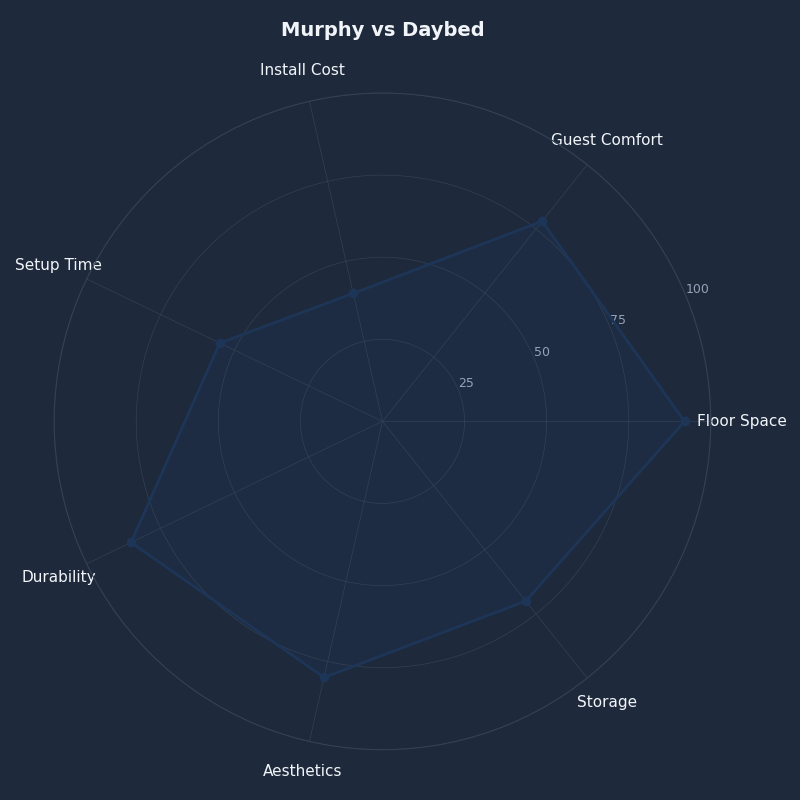
The radar chart above is the cleanest way to see the trade pattern. Daybeds dominate on cost, install simplicity, mattress flexibility, and resale. Murphy beds dominate on deployed floor space and full-mattress sleep dimensions. Every other dimension is roughly a wash. If your priorities cluster on the daybed’s strong axes, the rubric will tell you the daybed wins, and the rubric is right more often than the vendor blogs admit.
The honest version of this comparison is not “it depends on your lifestyle.” It depends on three numbers. Measure your studio, count your guest-nights, look at your lease, and the answer is in the table above. For most renters in most American studios, that answer is a daybed with a trundle — and the Murphy bed is a premium product solving a problem narrower than the marketing suggests.
Sources and further reading
- Create-A-Bed FAQ on mechanism mattress thickness and weight ranges
- Easy DIY Murphy Bed mattress and piston compatibility guide
- Wallbeds by Wilding installation cost breakdown
You may also like



Leave a Reply