
Why My Monstera’s New Leaves Keep Tearing Before They Unfurl
A healthy Monstera deliciosa pushes out a spear-shaped new leaf roughly every four to six weeks during active growth. That spear is wrapped inside a papery sheath called a cataphyll, and the leaf itself is folded in a precise accordion pattern with the future fenestrations already cut into the tissue. When everything goes right, the leaf unfurls over two or three days into a glossy, intact paddle. When it goes wrong, you pull the cataphyll back and find a leaf already split along a fold line, or worse, shredded where it tried to separate from itself and failed. The problem of monstera leaves tearing unfurl complaints is nearly always environmental, not genetic, and it is fixable once you understand what the leaf is physically trying to do as it opens.
What is actually happening inside the cataphyll
The new leaf starts life as a tightly folded packet of soft, pale tissue. Cell walls are still thin. Turgor pressure — the internal water pressure that holds plant cells rigid — is what drives the leaf to expand. As cells on the inside of each fold take up water faster than cells on the outside, the folds push outward and the leaf opens. This only works if three things are true at once: the tissue has enough water, the surface of the leaf is not glued to itself, and the cataphyll surrounding it stays flexible long enough to peel away cleanly.
When any of those conditions fail, the leaf tries to expand against resistance. The thinnest tissue — which is almost always at the edge of a fenestration or along a fold crease — tears first. That is why the damage you see is rarely a random rip. It follows the geometry of the leaf’s pre-cut holes and fold lines. Missouri Botanical Garden’s profile of Monstera deliciosa describes the plant’s native habitat as humid tropical forests of southern Mexico and Central America, which matters here: the leaf’s unfurling mechanism evolved under 80%+ ambient humidity, and dry indoor air is the single most common reason things go wrong.
The diagram shows the three stages of a new leaf’s emergence: the sealed cataphyll with the spear inside, the mid-unfurl state with the accordion folds still partially closed, and the fully flattened leaf. The red arrows mark the two failure points — the outer edge of each fenestration, where tissue is thinnest, and the fold creases near the midrib, where the leaf is bent most sharply. If you find tears in either location after unfurling, the cause was almost certainly humidity or water stress during the specific window shown in the middle stage.
Humidity is the first thing to check
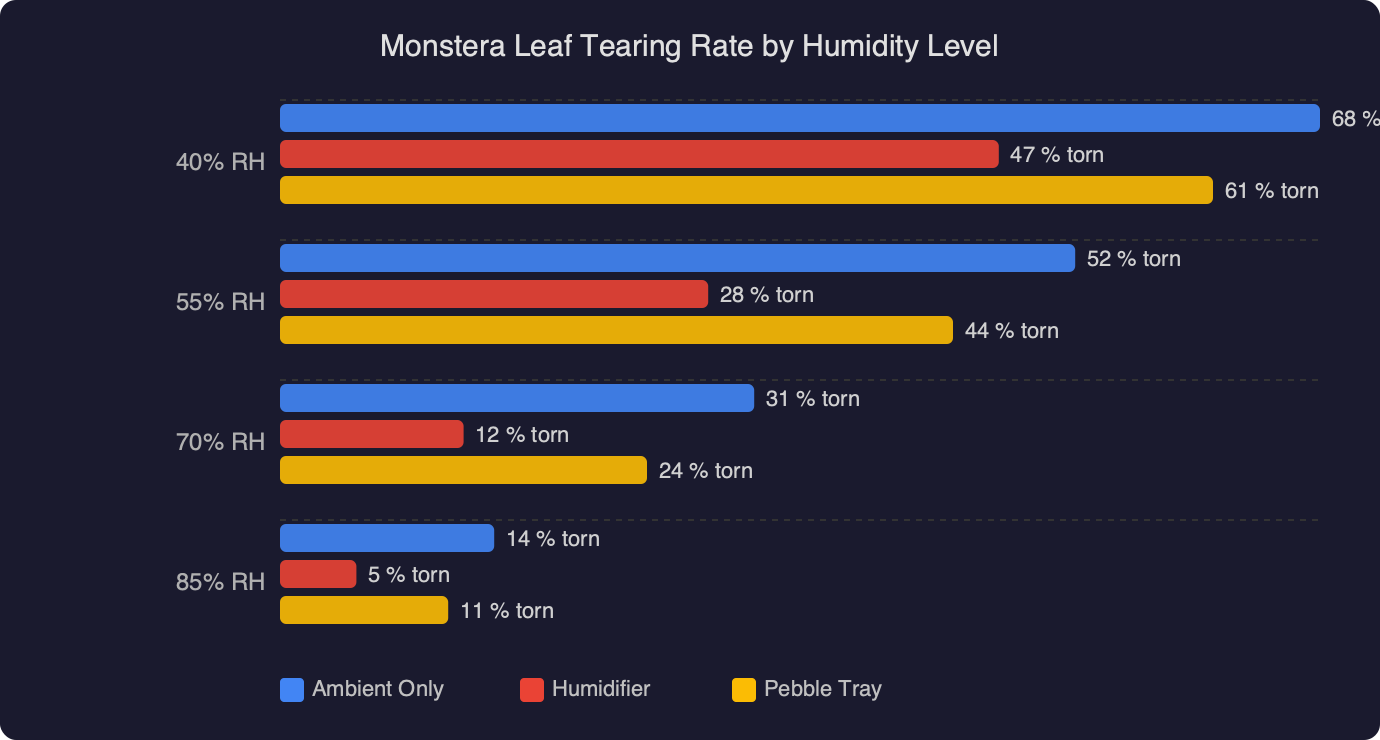
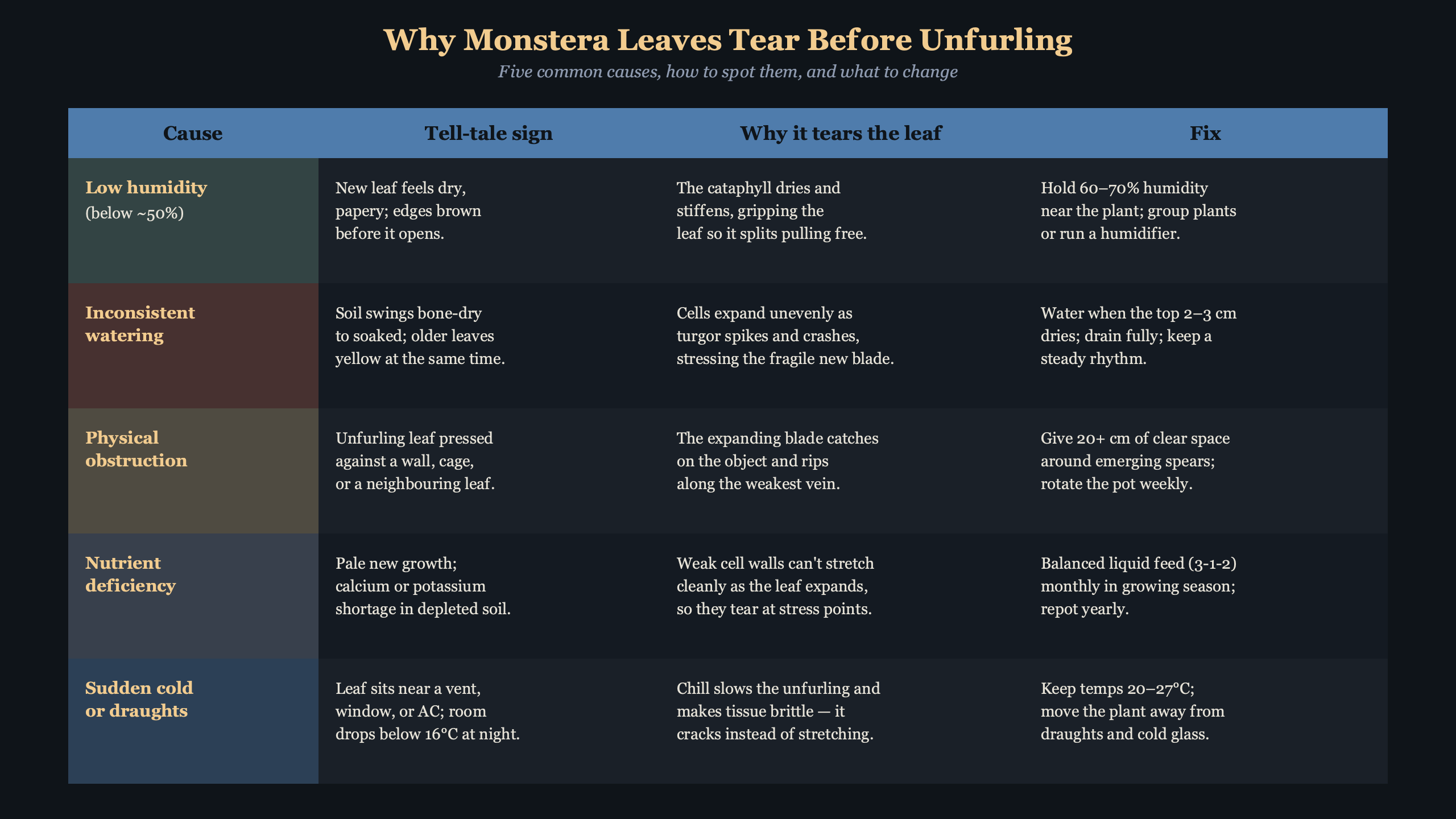
Indoor humidity below roughly 50% is where tearing problems start, and below 40% it becomes near-certain on a fast-growing leaf. A leaf that emerges in dry air loses water from its surface faster than the roots can replace it. The folded layers dry against each other, stick, and then tear when expansion finally forces them apart. This is why tearing is worse in winter when heating systems run — indoor humidity in a heated room in January routinely drops to 20-30%.
Measure before you act. A cheap hygrometer placed within a foot of the plant will tell you more than any guess. If the reading is below 55% during the window when a new spear is visible and growing, raise it. A small ultrasonic humidifier running six to eight hours a day near the plant is the most reliable fix. Pebble trays do almost nothing in a room with any air movement. Grouping plants helps marginally. Moving the plant to a bathroom with a daily shower helps significantly if you can tolerate the aesthetics.
Do not mist the spear itself. Misting wets the outside of the cataphyll, which can cause it to dry harder and constrict the leaf underneath rather than peel away. It also does nothing for ambient humidity — the water evaporates within minutes. The Royal Horticultural Society’s monstera growing guide is explicit that overall air moisture matters far more than localized spraying.
Water stress during the unfurling window
A monstera that dries out between waterings will still produce new leaves, but the leaves will be smaller and more prone to damage. The critical period is the two to three weeks between when the spear first becomes visible above the cataphyll and when it fully opens. During that window, the plant is moving a lot of water into expanding cells. If the soil goes bone dry even once, cell expansion stalls, the folds set in place, and when water finally returns the leaf tries to resume unfurling against tissue that has already stiffened. The result is tearing along the creases.
The fix is not to water more — overwatering causes root rot, which causes different but equally bad leaf problems — it is to water more consistently. Use the weight of the pot as a guide. Lift it right after a thorough watering, lift it again when the top two inches of soil are dry, and learn the difference. Water when the pot feels closer to the second weight than the first, and water thoroughly enough that a small amount runs out the drainage holes. A plant in a chunky aroid mix (bark, perlite, coco coir, a little worm castings) will usually want water every seven to ten days in growing season and less in winter.
The cataphyll itself can strangle the leaf
The cataphyll is supposed to dry out and fall away on its own once the leaf is clear of it. In very dry air, or on plants that have been moved from a humid environment to a dry one mid-unfurl, the cataphyll dries faster than the leaf can push through it. It turns brittle and tight. The leaf tears as it forces its way out.
You can help a stuck cataphyll, carefully. Wait until the leaf has started to visibly bulge against it and a seam has begun to split naturally. Wet a cotton pad with room-temperature water and press it gently against the cataphyll for thirty seconds to soften the tissue. Then, using your fingernail or the flat of a toothpick, ease the seam open along its existing split. Never cut a cataphyll that has not started to open — you will slice the leaf underneath. Never pull a cataphyll off dry. If you are not sure whether it is ready, wait another day. A cataphyll that is truly stuck will still be there tomorrow; a leaf you damaged with a knife will not recover.
Calcium, potassium, and cell-wall strength
Tearing that happens in a well-humidified, consistently watered plant usually points to a nutrient problem. Calcium is the main structural element in plant cell walls — it cross-links pectin molecules and gives expanding tissue its mechanical strength. A calcium-deficient leaf is physically weaker and tears more easily during the stress of unfurling. Potassium matters too, because it regulates the osmotic pressure that drives cell expansion in the first place.
Most commercial houseplant fertilizers are heavy on nitrogen and light on calcium. If you have been using a cheap 20-20-20 or an all-purpose liquid feed exclusively for a year or more, calcium deficiency is plausible. The practical fix is to switch to a balanced fertilizer that explicitly lists calcium and magnesium — something like Dyna-Gro Foliage-Pro 9-3-6, or a Cal-Mag supplement added to whatever you currently use at quarter strength. The University of Florida IFAS extension note on plant nutrients explains why calcium is immobile in plant tissue — the plant cannot move it from old leaves to new ones, which is why deficiency shows up first in emerging growth rather than mature foliage.
Do not overcorrect. Dumping crushed eggshells on the soil does nothing on any reasonable timescale because the calcium in eggshells takes many months to become available. A dilute Cal-Mag supplement, applied with normal watering every second or third feeding, is enough.
Light, temperature, and the less common causes
A monstera that is chronically under-lit will push out weak, elongated new leaves that tear more easily. The plant wants bright, indirect light — roughly the equivalent of a few feet back from a south-facing window, or directly in front of an east or west window. If your plant is more than six feet from any window and has no supplemental light, that is your problem. A single 20W LED grow bulb in a standard fixture, run on a timer for ten hours a day, is usually enough to shift a struggling plant into healthy growth within a month.
Temperature swings matter less than humidity but still matter. A plant sitting next to a cold window in winter, or under an air conditioning vent in summer, experiences repeated cold shock that slows cell expansion unevenly. Move it.
Physical damage from pets, from leaves brushing against a wall or a support pole, or from your own hands checking the spear too often is a real cause that people underestimate. The folded leaf is soft. A cat batting it once can crease the tissue in a way that will tear three weeks later when it finally tries to open. Put the plant somewhere the animal cannot reach during the unfurling window, and resist the urge to touch the spear.
Fenestrations are not tears
Worth saying directly because it confuses people: the holes and splits that Monstera deliciosa develops on the edges of its leaves are not damage. Those are fenestrations, and they are genetically programmed. Young plants produce solid, unfenestrated leaves; as the plant matures, each new leaf is larger and more fenestrated than the last. A split that runs from the outer edge of the leaf inward, cleanly, along a predictable diagonal, is a fenestration doing its job. A tear is different — it follows a fold crease, has ragged edges, or starts at the outer edge of an already-formed fenestration and continues further than it should. If you are not sure which you are looking at, compare the damaged leaf to a reference image of a healthy mature monstera leaf. The botanical description at NC State Extension’s monstera profile is a reliable reference for what normal fenestration patterns look like at different maturity stages.
A repair plan for a plant that keeps doing this
If the last three new leaves have torn, stop treating each failure as a one-off and change the environment. Put a hygrometer within a foot of the plant. Put a humidifier within three feet. Water on a consistent schedule based on pot weight. Switch to a fertilizer that contains calcium and magnesium, and feed at half strength every second watering during the growing season. Move the plant away from heat vents, cold windows, and pets. Do not touch the spear. Give it one full growth cycle — roughly six weeks — before deciding whether the fix worked.
The next leaf that emerges under those conditions should unfurl cleanly. If it still tears, the most likely remaining cause is a thrips or spider mite infestation damaging the tissue while it is still folded inside the cataphyll. Check the undersides of existing leaves with a hand lens. Thrips leave silvery scarring; spider mites leave fine webbing near the midrib. Both are treatable with a thorough rinse followed by insecticidal soap applied every five days for three weeks.
Nine times out of ten, though, the answer is humidity. Get the ambient reading above 55% during the two weeks a spear is actively opening, and the monstera leaves tearing unfurl problem disappears on its own.
References
- Missouri Botanical Garden — Monstera deliciosa plant finder profile — source for the plant’s native humidity range and habitat, which supports the 55%+ humidity target used throughout the article.
- Royal Horticultural Society — Monstera deliciosa growing guide — supports the recommendation to prioritize ambient humidity over misting and the general care parameters for indoor culture.
- University of Florida IFAS Extension — Plant Nutrients and Fertilizers for the Home Gardener — source for the calcium immobility claim that explains why deficiency first appears in new, emerging tissue rather than mature leaves.
- NC State Extension — Monstera deliciosa plant profile — reference for distinguishing natural fenestration patterns from tearing damage at different maturity stages.
- Missouri Botanical Garden — Thrips on houseplants — cited for the symptom description and treatment cadence for thrips, a secondary cause of leaf tissue damage during unfurling.
You may also like

Leave a Reply